Here's the truth that the fitness industry doesn't want you to hear: you don't need a gym membership, fancy equipment, or expensive classes to get strong after 50. Your own body is the best piece of equipment you'll ever own — and it's completely free.
Bodyweight exercises are the foundation of functional fitness. They train the exact movement patterns you use every single day — sitting, standing, reaching, bending, climbing, and balancing. And because there's no external load to manage, they're inherently safer for joints, easier to modify, and can be done anywhere — your lounge room, backyard, hotel room, or local park.
After 50, we lose roughly 1–2% of muscle mass per year if we're not actively training. Bodyweight exercises can slow, stop, and even reverse this decline. Here are the 10 best ones to start with.
1. Squats
The squat is the king of all functional exercises. Every time you sit down in a chair, get out of a car, or pick something up from the floor, you're squatting. Lose the ability to squat well, and your independence starts to slip away.
How to Do Them
- Stand with feet slightly wider than hip-width apart, toes turned out about 15–30 degrees
- Push your hips back and bend your knees — imagine sitting into a chair behind you
- Go as low as you comfortably can while keeping your chest up and heels on the floor
- Drive through your heels to stand back up, squeezing your glutes at the top
Modification: Place a chair behind you and squat until your glutes touch it, then stand back up. This gives you a safety net and builds confidence.
Do: 3 sets of 10–12 reps
2. Push-Ups (Modified)
Push-ups build your chest, shoulders, triceps, and core all at once. They're one of the best indicators of overall upper-body strength — and they're completely scalable for any fitness level.
How to Do Them
- Wall push-ups (easiest): Stand arm's length from a wall, place your hands flat against it at shoulder height, and push yourself away
- Incline push-ups: Place your hands on a bench, sturdy table, or kitchen counter — the higher the surface, the easier the exercise
- Knee push-ups: On the floor with knees down, keep your body in a straight line from head to knees
- Full push-ups: On your toes, body in a straight line from head to heels
Pro tip: Start wherever you are. There's absolutely no shame in wall push-ups — they still build real strength. Progress to the next level when you can comfortably do 3 sets of 12.
Do: 3 sets of 8–12 reps
3. Glute Bridges
Weak glutes are the hidden cause behind an enormous number of problems in women over 50 — lower back pain, hip pain, knee pain, poor posture, and difficulty walking. Your glutes are the largest muscle group in your body, and glute bridges are the safest, most effective way to wake them up.
How to Do Them
- Lie on your back with knees bent, feet flat on the floor about hip-width apart
- Push through your heels to lift your hips toward the ceiling
- Squeeze your glutes hard at the top — hold for 2–3 seconds
- Lower slowly back down
Progression: Once you've mastered the basic version, try single-leg glute bridges — extend one leg straight out and bridge with the other.
Do: 3 sets of 12–15 reps
4. Step-Ups
Step-ups directly mimic one of the most important daily movements — climbing stairs. They build single-leg strength, balance, and coordination, all of which decline rapidly after 50 without targeted training.
How to Do Them
- Stand facing a sturdy step, staircase, or low bench (15–25 cm to start)
- Place your entire right foot firmly on the step
- Drive through your right heel to step up, bringing your left foot to meet it
- Step back down with control
- Complete all reps on one side, then switch
Modification: Hold onto a railing or wall for balance when starting out. As you get stronger, try it hands-free.
Do: 3 sets of 8–10 per leg
5. Wall Sits
Wall sits are a brilliant isometric exercise — your muscles work hard without moving. They build incredible quad endurance and knee stability with zero impact on your joints. They're also proven to help lower blood pressure, which is a common concern after 50.
How to Do Them
- Stand with your back flat against a wall, feet about 60 cm from the wall
- Slide down until your thighs are roughly parallel to the floor (or as low as comfortable)
- Keep your back pressed firmly against the wall, knees above ankles
- Hold — and breathe!
Modification: Don't slide as low. A quarter-squat position is still excellent for building strength.
Do: 3 holds of 20–45 seconds
6. Bird Dogs
Bird dogs are one of the most effective exercises for core stability, lower back health, and coordination. They train your body to stabilise while moving opposite limbs — a skill that directly translates to walking, reaching, and everyday balance.
How to Do Them
- Start on all fours — hands under shoulders, knees under hips
- Simultaneously extend your right arm forward and left leg backward
- Keep your back flat and hips level — imagine balancing a glass of water on your lower back
- Hold for 2–3 seconds, then return to start
- Repeat on the opposite side (left arm, right leg)
Pro tip: Move slowly and with control. Speed is the enemy of this exercise — the slower you go, the harder your core works.
Do: 3 sets of 8–10 per side
7. Dead Bugs
Get your FREE 7-Day Beginner Workout Plan
A gentle, progressive week of strength, cardio, flexibility and balance — designed just for women over 50. Pop in your details and I'll send it straight away. 💪
Dead bugs are a spine-friendly core exercise that trains your deep abdominal muscles without the neck and back strain of traditional crunches. They're particularly important for women over 50 because they strengthen the muscles that protect your spine during everyday movements.
How to Do Them
- Lie on your back with arms extended toward the ceiling and knees bent at 90 degrees (shins parallel to the floor)
- Press your lower back firmly into the floor — this is your anchor point
- Slowly lower your right arm overhead and left leg toward the floor simultaneously
- Return to start, then repeat on the opposite side
Key focus: Your lower back should stay pressed into the floor throughout. If it starts to arch, you've gone too far — reduce your range of motion.
Do: 3 sets of 8–10 per side
8. Calf Raises
Calf raises might seem simple, but they're critically important for balance, ankle stability, and fall prevention after 50. Your calves power every step you take and act as a pump for blood circulation in your lower legs.
How to Do Them
- Stand with feet hip-width apart (hold a wall or chair for balance if needed)
- Rise up onto your toes, lifting your heels as high as possible
- Hold at the top for 2 seconds, squeezing your calves
- Lower slowly back down (3 seconds down)
Progression: Try single-leg calf raises once you can comfortably do 15 reps on both legs. Standing on a step with your heels hanging off the edge increases the range of motion.
Do: 3 sets of 12–15 reps
9. Lunges
Lunges build single-leg strength, hip flexibility, and balance all at once. They're one of the most functional exercises you can do — mimicking the movement patterns of walking, climbing, and getting up from the ground.
How to Do Them
- Stand tall with feet together
- Take a big step forward with your right foot
- Lower your back knee toward the floor until both knees are at roughly 90 degrees
- Push through your front heel to return to standing
- Alternate legs
Modification: If forward lunges feel unstable, try reverse lunges (stepping backward instead) — they're easier on the knees and give you more control. You can also hold onto a chair for balance.
Do: 3 sets of 8–10 per leg
10. Plank Hold
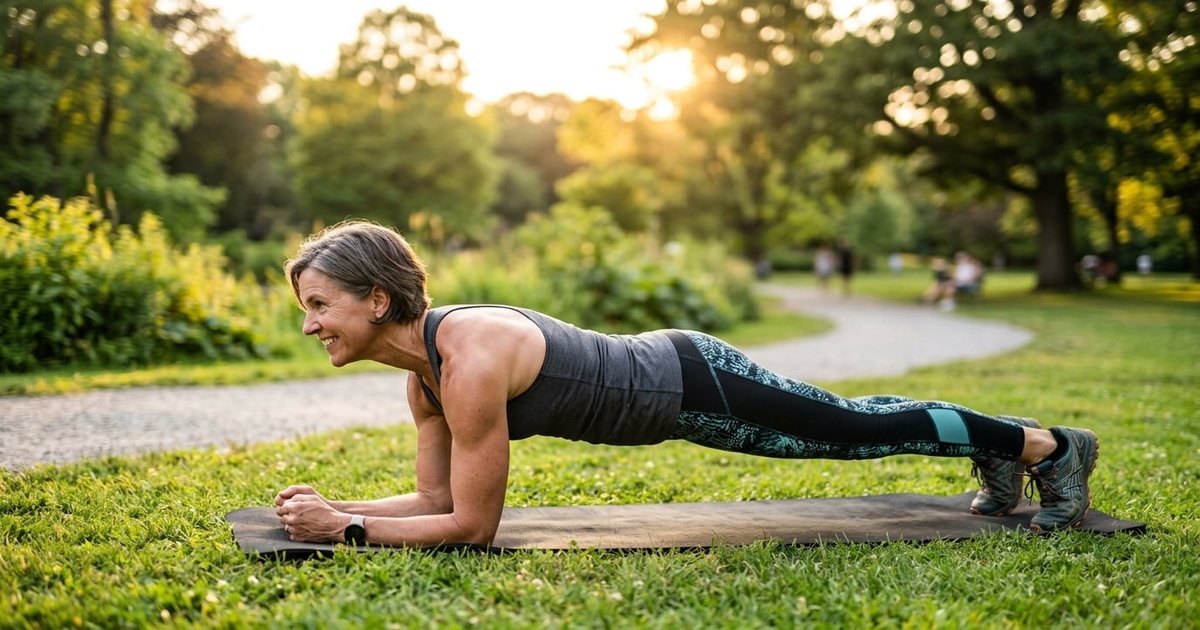
The plank is the ultimate full-body isometric exercise. It trains your entire core (front, sides, and back), shoulders, and glutes simultaneously. A strong plank translates directly to better posture, reduced back pain, and improved stability in everything you do.
How to Do It
- Wall plank (easiest): Place your hands on a wall and hold your body at an angle
- Incline plank: Hands on a bench or counter, body straight from head to heels
- Forearm plank: On the floor, elbows under shoulders, body in a straight line
- Keep your core tight, glutes squeezed, and don't let your hips sag or pike up
Pro tip: Quality over duration. A 20-second plank with perfect form beats a 60-second plank with your hips sagging. Build up gradually.
Do: 3 holds of 15–45 seconds
Your 25-Minute Full-Body Bodyweight Workout
Here's a complete workout using all 10 exercises. Do this 2–3 times per week for incredible results.
| Exercise | Sets | Reps / Time | Rest |
|---|---|---|---|
| Squats | 3 | 10–12 reps | 45 sec |
| Push-Ups (your level) | 3 | 8–12 reps | 45 sec |
| Glute Bridges | 3 | 12–15 reps | 30 sec |
| Step-Ups (each leg) | 2 | 8–10 reps | 30 sec |
| Wall Sits | 2 | 20–30 sec hold | 30 sec |
| Bird Dogs (each side) | 2 | 8–10 reps | 30 sec |
| Dead Bugs (each side) | 2 | 8–10 reps | 30 sec |
| Calf Raises | 2 | 12–15 reps | 30 sec |
| Lunges (each leg) | 2 | 8–10 reps | 30 sec |
| Plank Hold | 2 | 15–30 sec | 30 sec |
Warm-up: 3–5 minutes of marching on the spot, arm circles, and gentle leg swings.
Cool-down: 3–5 minutes of static stretching — quad stretch, hamstring stretch, chest opener, and gentle spinal twist.
Why Bodyweight Training Is Perfect After 50
- Zero cost: No gym, no equipment, no excuses
- Joint-friendly: You control the load entirely — your body weight is the resistance
- Infinitely scalable: Every exercise has easier and harder versions
- Functional: These movements directly improve your ability to do everyday tasks
- Do it anywhere: Home, park, hotel, backyard — no barriers
- Builds confidence: Mastering your own bodyweight is incredibly empowering
Final Thoughts
You don't need a gym. You don't need equipment. You don't need hours of time. Just 25 minutes, 2–3 times per week, using nothing but your own body weight, will transform your strength, balance, mobility, and confidence.
Start with the modifications if you need them. Progress when you're ready. The only workout you'll regret is the one you didn't do. 💪
Get your FREE 7-Day Beginner Workout Plan
A gentle, progressive week of strength, cardio, flexibility and balance — designed just for women over 50. Pop in your details and I'll send it straight away. 💪