Here's a statistic that might surprise you: one in three adults over 65 will experience a fall each year, and for women, the risk starts climbing well before that. But here's the empowering truth — most falls are preventable, and the single most effective thing you can do is improve your balance.
Balance isn't something you either have or don't. It's a skill that can be trained, strengthened, and improved at any age. The muscles, reflexes, and systems that keep you steady respond beautifully to regular practice — even just 5–10 minutes a day can make a significant difference.
These five exercises are gentle, require no equipment, and can be done in your living room. Start today, and within a few weeks you'll feel noticeably more stable and confident on your feet.
Why Balance Deteriorates After 50
Understanding why balance declines helps us target it effectively:
- Muscle loss — we lose 3–5% of muscle mass per decade after 30, affecting the stabilising muscles in our ankles, knees, and hips
- Reduced proprioception — the sensory receptors in our joints that tell our brain where our body is in space become less sensitive
- Inner ear changes — the vestibular system that controls our sense of spatial orientation can decline
- Vision changes — reduced depth perception and visual acuity affect how we navigate our environment
- Slower reflexes — the speed at which we can react to a stumble decreases with age
The good news? All of these factors can be improved with targeted balance training.
1. Single-Leg Stand
This is the foundation of all balance training — simple, effective, and something you can practice every single day while waiting for the kettle to boil.
How to do it:
- Stand beside a sturdy chair or kitchen bench (for support if needed)
- Shift your weight onto your left foot
- Slowly lift your right foot a few centimetres off the floor
- Stand tall with your core engaged and eyes focused on a fixed point ahead
- Hold for 20–30 seconds (or as long as you can)
- Switch to the other leg
- Repeat 3 times each side
Top tip: As you get stronger, try letting go of the chair. Then try closing your eyes — this removes visual input and dramatically increases the challenge to your balance system.
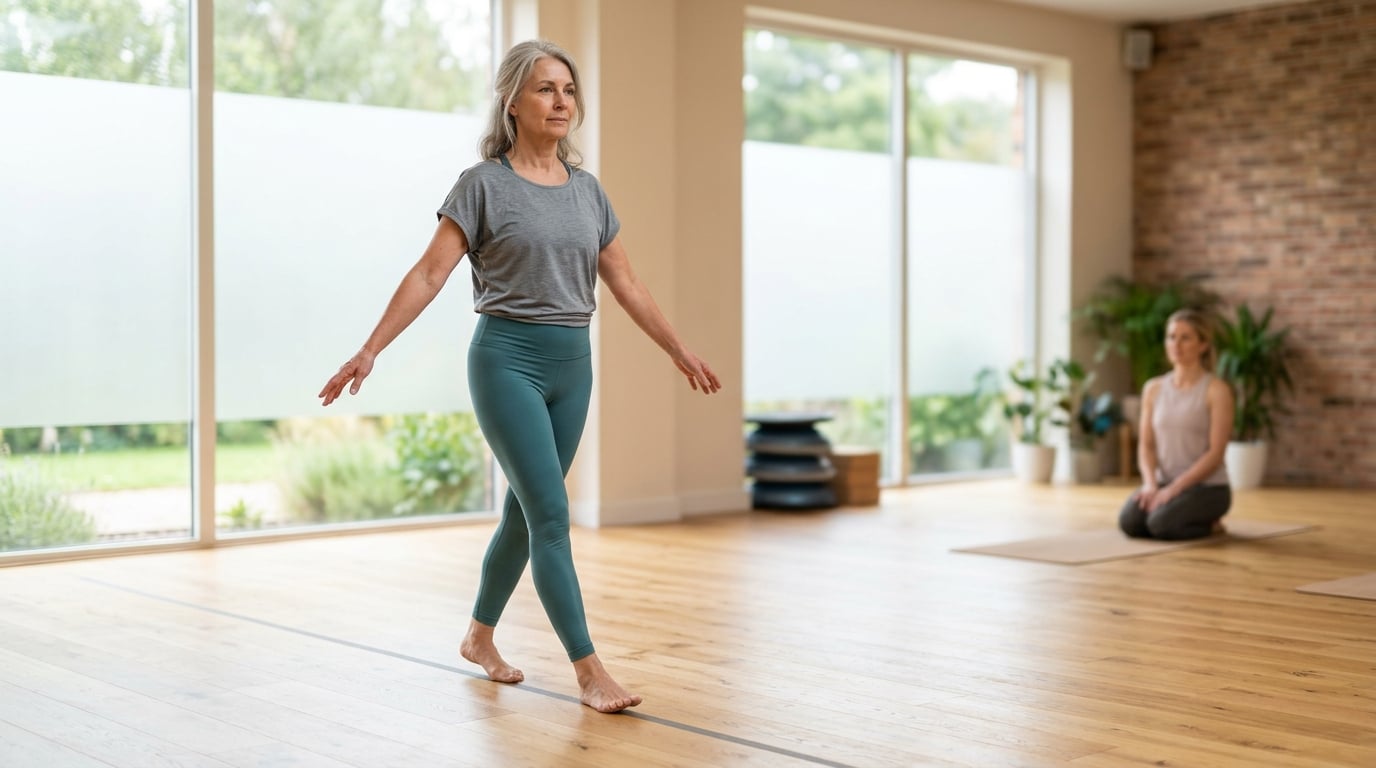
2. Heel-to-Toe Walk (Tandem Walk)
This exercise mimics walking on a tightrope and trains the kind of dynamic balance you need when navigating uneven surfaces, tight spaces, or crowded footpaths.
How to do it:
- Stand at one end of a clear hallway or room
- Place your right heel directly in front of your left toes, touching heel to toe
- Step forward with your left foot, placing that heel directly in front of your right toes
- Continue for 15–20 steps, keeping your gaze fixed on a point ahead
- Turn around and walk back
- Repeat 3 times
Top tip: Hold your arms out to the sides for balance at first. As you improve, try placing your hands on your hips. Walk near a wall so you can steady yourself if needed.
3. Sit-to-Stand (Without Hands)
Get your FREE 7-Day Beginner Workout Plan
A gentle, progressive week of strength, cardio, flexibility and balance — designed just for women over 50. Pop in your details and I'll send it straight away. 💪
This functional exercise strengthens the muscles you use every time you get up from a chair, the toilet, or the car — and it's one of the best predictors of fall risk and overall functional fitness.
How to do it:
- Sit on the edge of a sturdy chair with feet flat on the floor, hip-width apart
- Cross your arms over your chest
- Lean slightly forward and press through your heels to stand up without using your hands
- Pause at the top, standing tall
- Slowly lower yourself back down with control — don't plop!
- Repeat 10–12 times for 3 sets
Top tip: If standing without hands is too difficult at first, lightly rest your fingertips on the chair arms for minimal assistance. The goal is to gradually reduce how much you rely on your hands.
4. Clock Reach
This dynamic exercise challenges your balance in multiple directions, training the stabilising muscles around your ankles, knees, and hips to respond to shifts in your centre of gravity.
How to do it:
- Stand on your left foot (hold a chair if needed)
- Imagine you're standing in the centre of a clock face
- Reach your right foot forward to 12 o'clock, tap the floor gently, and return to centre
- Reach your right foot to 3 o'clock (out to the side), tap and return
- Reach your right foot to 6 o'clock (behind you), tap and return
- That's one set. Do 5 sets on each leg
Top tip: Keep your standing leg slightly bent and your core engaged throughout. The further you reach, the harder it is — start small and increase your reach as your balance improves.
5. Weight Shifts
This gentle exercise is perfect for beginners and teaches your body to control its centre of gravity — the fundamental skill behind all balance.
How to do it:
- Stand with feet hip-width apart, hands on hips
- Slowly shift your weight onto your right foot, lifting your left foot slightly off the floor
- Hold for 5 seconds
- Slowly shift your weight to the left foot, lifting your right foot slightly
- Hold for 5 seconds
- Continue shifting side to side for 20 shifts total (10 each side)
- Then shift forward and backward: rock onto your toes, then back onto your heels
- Do 10 forward-backward shifts
Top tip: Focus on making the transitions smooth and controlled. The slower you go, the more challenging it becomes for your balance muscles.
Your Daily Balance Routine
Combine all five exercises for an 8-minute fall-prevention routine:
- Weight Shifts — 20 side-to-side + 10 forward-backward
- Single-Leg Stand — 30 seconds each side × 3
- Heel-to-Toe Walk — 20 steps × 3
- Clock Reach — 5 sets each leg
- Sit-to-Stand — 12 reps × 3 sets
Do this routine daily — morning or evening, whichever suits your schedule. It takes less than 10 minutes and the results are genuinely life-changing.
Additional Tips for Fall Prevention
- Good lighting: Ensure your home is well-lit, especially hallways and stairways
- Remove trip hazards: Secure loose rugs, clear clutter from walkways, and manage electrical cords
- Proper footwear: Wear supportive, non-slip shoes — avoid walking in socks on hard floors
- Regular eye checks: Update your prescription and have annual eye exams
- Stay active: General fitness improves balance — walking, swimming, and strength training all help
- Review medications: Some medications can cause dizziness — talk to your GP if you feel unsteady
Remember: Every minute you spend practising balance is an investment in your independence. These exercises aren't just about preventing falls — they're about giving you the confidence to walk on uneven ground, play with grandkids, travel, and live your life fully without fear. Start today! 💚
Get your FREE 7-Day Beginner Workout Plan
A gentle, progressive week of strength, cardio, flexibility and balance — designed just for women over 50. Pop in your details and I'll send it straight away. 💪