One of the biggest barriers to exercise after 50 is the belief that you need a gym membership, expensive equipment, or fancy gadgets to get a good workout. But the truth is, your own body weight is the most versatile piece of "equipment" you'll ever own.
Bodyweight exercises have been used for centuries to build strength, flexibility, and endurance. They're free, they travel with you, and they can be modified to suit any fitness level — from complete beginner to seasoned exerciser.
These five exercises target every major muscle group in your body, require zero equipment, and can be done in your living room, hotel room, garden, or anywhere you have a bit of space. No excuses — just results!
Why Bodyweight Training Works So Well After 50
- No equipment needed — exercise anywhere, anytime, with no barriers to getting started
- Natural movement patterns — bodyweight exercises mirror real-life movements, building functional strength
- Joint-friendly — you're only lifting your own weight, which is gentler on joints than heavy external loads
- Easily modified — every exercise can be made easier or harder to match your current fitness level
- Improves balance — bodyweight exercises require stabilisation, which naturally improves balance
- Builds bone density — weight-bearing exercises signal your bones to stay strong
1. Wall Push-Up (Progressing to Floor)
Push-ups are the ultimate upper body exercise, and starting against a wall makes them accessible to everyone. They strengthen your chest, shoulders, triceps, and core all at once.
How to do it:
- Stand arm's length from a wall, palms flat on the wall at shoulder height
- Bend your elbows to lower your chest towards the wall, keeping your body straight
- Push back to the starting position
- Repeat 10–15 times for 3 sets
Progression:
- Level 1: Wall push-up (standing)
- Level 2: Incline push-up (hands on kitchen bench or sturdy chair)
- Level 3: Knee push-up (on the floor, knees down)
- Level 4: Full push-up (on the floor, toes down)
Top tip: Keep your core tight and your body in a straight line throughout. Don't let your hips sag or pike up. Move to the next level only when you can comfortably complete 3 sets of 15 reps.
2. Bodyweight Squat
Squats are the king of lower body exercises. They strengthen your quads, glutes, and hamstrings — the muscles that power every step, every stair climb, and every time you stand up from a chair.
How to do it:
- Stand with feet slightly wider than hip-width apart, toes turned out slightly
- Extend your arms in front of you for balance, or place hands on hips
- Push your hips back and bend your knees as if sitting into an invisible chair
- Lower until your thighs are parallel to the floor (or as far as comfortable)
- Press through your heels to stand back up, squeezing your glutes at the top
- Repeat 12–15 times for 3 sets
Top tip: Keep your chest lifted and weight in your heels — you should be able to wiggle your toes throughout the movement. If depth is an issue, place a chair behind you and squat until you touch it.
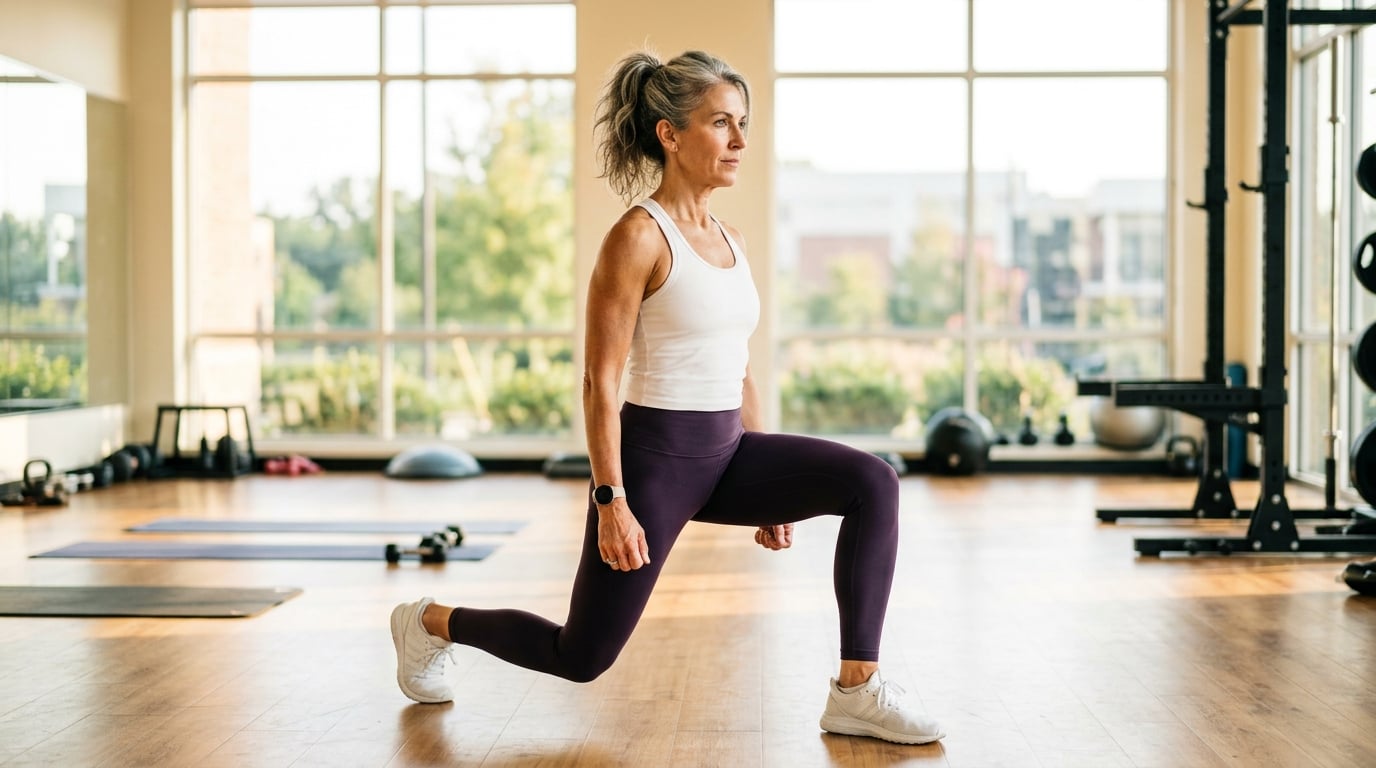
3. Reverse Lunge
Get your FREE 7-Day Beginner Workout Plan
A gentle, progressive week of strength, cardio, flexibility and balance — designed just for women over 50. Pop in your details and I'll send it straight away. 💪
Lunges are brilliant for building single-leg strength, which directly translates to better balance, easier stair climbing, and more confident walking. Stepping backward (reverse lunge) is easier on your knees than stepping forward.
How to do it:
- Stand tall with feet hip-width apart, hands on hips
- Step your right foot back about 60–90cm
- Lower your back knee towards the floor until both knees are at roughly 90 degrees
- Press through your front heel to step your right foot back to the starting position
- Repeat on the other side
- Do 10 reps each leg for 3 sets
Top tip: Hold onto a chair or wall for balance if needed. Focus on dropping your back knee straight down rather than lunging forward — this keeps the movement controlled and protects your front knee.
4. Glute Bridge
The glute bridge targets your posterior chain — glutes, hamstrings, and lower back — muscles that are often weak from sitting. Strong glutes are essential for pelvic stability, back health, and powerful movement.
How to do it:
- Lie on your back with knees bent, feet flat on the floor, hip-width apart
- Arms by your sides, palms down
- Press through your heels to lift your hips until your body forms a straight line from shoulders to knees
- Squeeze your glutes hard at the top and hold for 3 seconds
- Slowly lower back down
- Repeat 12–15 times for 3 sets
Top tip: Drive through your heels, not your toes. If you feel this in your lower back instead of your glutes, try moving your feet slightly further away from your body. For an extra challenge, try single-leg bridges!
5. Bird Dog
The bird dog is a phenomenal exercise for core stability, back strength, and coordination. It trains your body to stabilise while moving — exactly what you need for everyday activities.
How to do it:
- Start on all fours with wrists under shoulders and knees under hips
- Keep your back flat and core engaged
- Slowly extend your right arm forward and left leg back simultaneously
- Hold for 3 seconds, keeping your hips level (don't let them rotate)
- Return to start with control
- Repeat on the other side (left arm, right leg)
- Do 10 reps each side for 3 sets
Top tip: Imagine balancing a cup of tea on your lower back — if it would spill, you're rotating too much. The slower and more controlled you are, the more effective this exercise becomes.
Your 20-Minute Bodyweight Workout
Combine all five exercises for a complete full-body session:
- 3-minute warm-up (marching on the spot, arm circles, hip circles)
- Wall/Incline Push-Ups — 15 reps × 3 sets (60-second rest between sets)
- Bodyweight Squats — 15 reps × 3 sets
- Reverse Lunges — 10 reps each leg × 3 sets
- Glute Bridges — 15 reps × 3 sets
- Bird Dogs — 10 reps each side × 3 sets
- Cool-down stretches (2–3 minutes)
Do this routine 3 times per week. It takes just 20 minutes and works every major muscle group in your body. As you get stronger, increase reps, add a pause at the hardest point, or slow down each rep for extra challenge.
Making Bodyweight Exercises Harder (Without Equipment)
- Slow down: Take 3 seconds to lower and 3 seconds to rise — the slower you go, the harder it is
- Add a pause: Hold the hardest position for 3–5 seconds
- Increase range: Go deeper in squats and lunges as flexibility allows
- Single leg: Progress to single-leg squats, single-leg bridges, and single-leg deadlifts
- Add pulses: At the bottom of a squat or lunge, pulse up and down 5 times before standing
- Reduce rest: Shorten rest between sets from 60 seconds to 30 seconds
Remember: Your body is the only gym you'll ever need. These five exercises prove that you can build serious strength, improve your fitness, and feel amazing — all without spending a single dollar on equipment. The best workout is the one you actually do, and bodyweight training removes every excuse. Let's go! ❤️
Get your FREE 7-Day Beginner Workout Plan
A gentle, progressive week of strength, cardio, flexibility and balance — designed just for women over 50. Pop in your details and I'll send it straight away. 💪