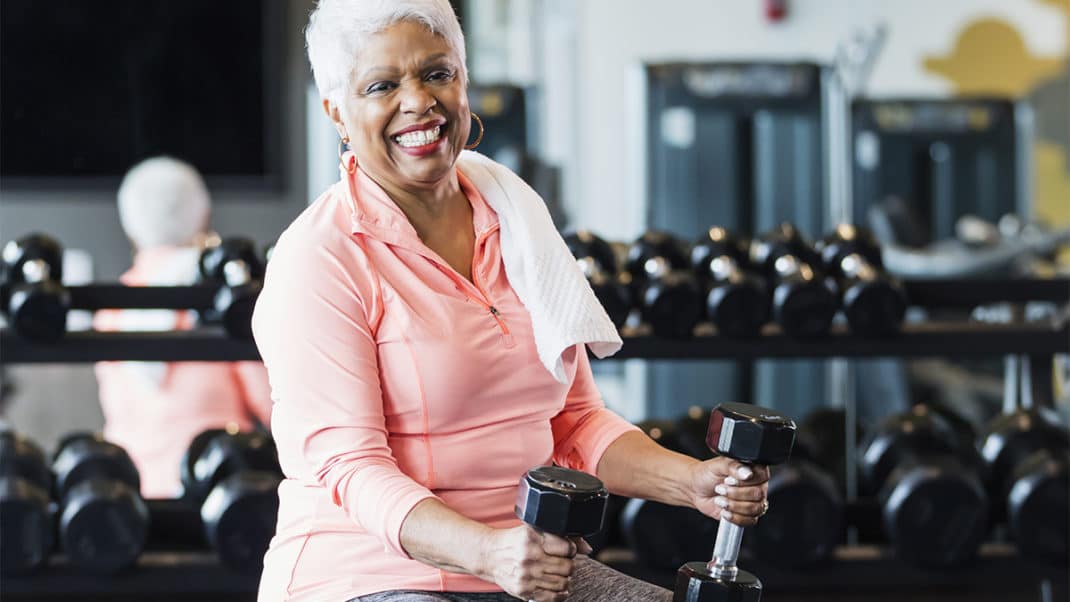
If you could only use one piece of equipment for the rest of your life, make it a pair of dumbbells. They're versatile, affordable, available in every gym on the planet, and you can do hundreds of exercises with them — from full-body compound movements to targeted isolation work.
For women over 50, dumbbells are particularly brilliant because they allow you to train each side independently (fixing strength imbalances), move through a natural range of motion (easier on your joints than machines), and scale the difficulty simply by grabbing a heavier or lighter pair.
Here are the five best dumbbell exercises that will build strength, improve your posture, protect your bones, and keep you functionally independent for decades to come.
1. Goblet Squats
If you only learn one lower body exercise, make it the goblet squat. It's safer and more accessible than a barbell squat, it teaches perfect form, and it builds serious strength in your legs and glutes.
How to Do Them
- Hold a single dumbbell vertically against your chest, cupping the top end with both hands (like holding a goblet)
- Stand with feet slightly wider than hip-width, toes turned out about 15–30 degrees
- Push your hips back and bend your knees to lower into a squat — aim to get your thighs parallel to the ground (or as low as comfortable)
- Keep your chest up, elbows inside your knees, and weight in your heels
- Drive through your heels to stand back up, squeezing your glutes at the top
Why They Matter After 50
Every time you sit down in a chair, get out of a car, pick something up from the floor, or climb stairs, you're essentially doing a squat. Leg strength is the single biggest predictor of functional independence as you age. Weak legs = more falls, more fractures, more dependence on others. Strong legs = freedom.
The goblet position also forces you to keep your chest up and core engaged, which improves posture and protects your lower back. It's one of the safest squat variations available.
Programming
- Beginner: 4–6 kg dumbbell, 3 sets of 10–12 reps
- Intermediate: 8–12 kg dumbbell, 3 sets of 10–12 reps
- Advanced: 14–20 kg dumbbell, 4 sets of 8–10 reps
Pro tip: If you struggle with depth, place a bench or chair behind you and squat down until your glutes just touch it, then stand back up. This gives you a target and builds confidence.
2. Bent-Over Rows
Your back is one of the most important muscle groups to train after 50 — and one of the most neglected. Bent-over rows target your entire posterior chain (upper back, lats, rear shoulders, and biceps), counteracting the forward-hunching posture that comes from years of desk work and phone use.
How to Do Them
- Stand with feet hip-width apart, holding a dumbbell in each hand
- Hinge forward at the hips (push your bum back) until your torso is roughly 45 degrees to the floor
- Let the dumbbells hang straight down, palms facing each other
- Pull the dumbbells up toward your ribcage, squeezing your shoulder blades together at the top
- Lower with control — don't just let them drop
Why They Matter After 50
Posture deteriorates with age — shoulders round forward, upper back curves, chin juts out. This isn't inevitable; it's a consequence of weak back muscles and tight chest muscles. Bent-over rows directly strengthen the muscles responsible for pulling your shoulders back and keeping your spine upright.
They also build the pulling strength you need for everyday tasks: opening heavy doors, pulling a suitcase, lifting things from the boot of your car, and gardening.
Programming
- Beginner: 3–5 kg dumbbells, 3 sets of 10–12 reps
- Intermediate: 6–10 kg dumbbells, 3 sets of 10–12 reps
- Advanced: 12–16 kg dumbbells, 4 sets of 8–10 reps
Pro tip: Focus on squeezing your shoulder blades together at the top of each rep — imagine you're trying to hold a pencil between them. This ensures you're using your back muscles, not just your arms.
3. Chest Press
The dumbbell chest press is a fundamental pushing exercise that targets your chest (pectorals), front shoulders, and triceps. It's more shoulder-friendly than a barbell bench press because dumbbells allow your arms to move in a natural arc.
How to Do Them
- Lie on a bench (or the floor) with a dumbbell in each hand
- Start with arms extended above your chest, palms facing forward
- Slowly lower the dumbbells until your elbows are at roughly 90 degrees (or the dumbbells are level with your chest)
- Press back up to the starting position, squeezing your chest at the top
- Keep your feet flat on the floor and your lower back in a natural arch
Why They Matter After 50
Chest strength is essential for pushing movements — pushing yourself up from the ground if you fall, pushing open heavy doors, pushing a shopping trolley, and getting out of bed. Women tend to have disproportionately weak chest muscles because they rarely train them directly.
The chest press also builds tricep strength (the backs of your arms) and front shoulder stability, making it a highly efficient upper body exercise.
Programming
- Beginner: 3–5 kg dumbbells, 3 sets of 10–12 reps
- Intermediate: 6–10 kg dumbbells, 3 sets of 10–12 reps
- Advanced: 12–16 kg dumbbells, 4 sets of 8–10 reps
No bench? Do floor presses instead — same movement, but lying on the floor. Your range of motion is slightly reduced, but it's still very effective and arguably safer for your shoulders.
4. Deadlifts
Get your FREE 7-Day Beginner Workout Plan
A gentle, progressive week of strength, cardio, flexibility and balance — designed just for women over 50. Pop in your details and I'll send it straight away. 💪
The dumbbell deadlift is one of the most functional exercises in existence. It mimics the exact movement pattern of picking something up from the floor — something you do dozens of times a day.
How to Do Them
- Stand with feet hip-width apart, holding a dumbbell in each hand in front of your thighs
- Push your hips back (imagine closing a car door with your bum) and lower the dumbbells along the front of your legs
- Keep your back flat and chest up — don't round your spine
- Lower until you feel a stretch in your hamstrings (usually around mid-shin level)
- Drive through your heels and squeeze your glutes to stand back up
Why They Matter After 50
The hip hinge pattern (bending at the hips while keeping your back neutral) is the most important movement pattern for protecting your lower back. Most back injuries happen because people round their spine when picking things up. Training deadlifts teaches your body to hinge properly, building the hamstring, glute, and lower back strength that keeps you injury-free.
Deadlifts also build serious posterior chain strength — your glutes, hamstrings, and lower back — which are crucial for walking, climbing stairs, and maintaining balance.
Programming
- Beginner: 4–6 kg dumbbells, 3 sets of 10–12 reps
- Intermediate: 8–12 kg dumbbells, 3 sets of 10–12 reps
- Advanced: 14–20 kg dumbbells, 4 sets of 8–10 reps
Pro tip: Film yourself from the side and check that your back stays flat throughout the movement. If it rounds, reduce the weight and focus on the hip hinge. A broomstick along your spine (touching your head, upper back, and tailbone) is a great way to practice.
5. Lateral Raises
Lateral raises isolate your medial deltoids — the muscles on the sides of your shoulders that give your upper body width, shape, and strength. They're a small exercise with a big impact.
How to Do Them
- Stand with feet hip-width apart, holding a light dumbbell in each hand by your sides
- With a slight bend in your elbows, raise both arms out to the sides until they're level with your shoulders
- Pause briefly at the top
- Lower slowly (3 seconds) back to your sides
- Keep your core engaged and avoid swinging or using momentum
Why They Matter After 50
Strong shoulders are essential for reaching, lifting, carrying, and overhead tasks. They also play a critical role in shoulder joint stability, which becomes increasingly important as we age. Lateral raises specifically strengthen the rotator cuff area, reducing your risk of shoulder injuries and impingement.
Aesthetically, well-developed shoulders improve your overall posture and create a beautiful, confident silhouette.
Programming
- Beginner: 1–2 kg dumbbells, 3 sets of 12–15 reps
- Intermediate: 3–4 kg dumbbells, 3 sets of 12–15 reps
- Advanced: 5–7 kg dumbbells, 4 sets of 10–12 reps
Pro tip: This exercise uses lighter weights than you'd think. If you're swinging, shrugging, or using momentum, the weight is too heavy. Drop down and do it with strict form — your shoulders will still burn!
A Complete 25-Minute Dumbbell Workout
Here's a full-body workout using just these five exercises. Do it 2–3 times per week with at least one rest day between sessions.
- Warm-up: 3 minutes of light marching, arm circles, and bodyweight squats
- Goblet Squats: 3 sets of 10–12 reps (rest 60–90 seconds)
- Bent-Over Rows: 3 sets of 10–12 reps (rest 60–90 seconds)
- Chest Press: 3 sets of 10–12 reps (rest 60–90 seconds)
- Deadlifts: 3 sets of 10–12 reps (rest 60–90 seconds)
- Lateral Raises: 3 sets of 12–15 reps (rest 60 seconds)
- Cool-down: 3 minutes of gentle full-body stretches
Total time: ~25 minutes. That's a complete, balanced, full-body workout with just one pair of dumbbells.
What Weight Dumbbells Should You Buy?
If you're training at home and need to buy dumbbells, here's what we recommend:
- Complete beginner: A set of 2 kg, 4 kg, and 6 kg pairs will cover everything you need for the first 3–6 months
- Some experience: Add 8 kg and 10 kg pairs for lower body exercises
- Budget option: Adjustable dumbbells (like Bowflex or similar) that go from 2–24 kg are a brilliant investment if you're serious about training at home
Expect to use lighter weights for isolation exercises (lateral raises) and heavier weights for compound movements (goblet squats, deadlifts).
The Bottom Line
You don't need a fancy gym membership, a personal trainer, or complicated equipment to build real strength after 50. A pair of dumbbells and these five exercises will work every major muscle group in your body, improve your posture, protect your bones, and keep you functionally independent.
Start with weights that challenge you but allow good form, train 2–3 times a week, and increase the weight gradually. Within 6–8 weeks, you'll be stronger than you've been in years. 💪
Get your FREE 7-Day Beginner Workout Plan
A gentle, progressive week of strength, cardio, flexibility and balance — designed just for women over 50. Pop in your details and I'll send it straight away. 💪