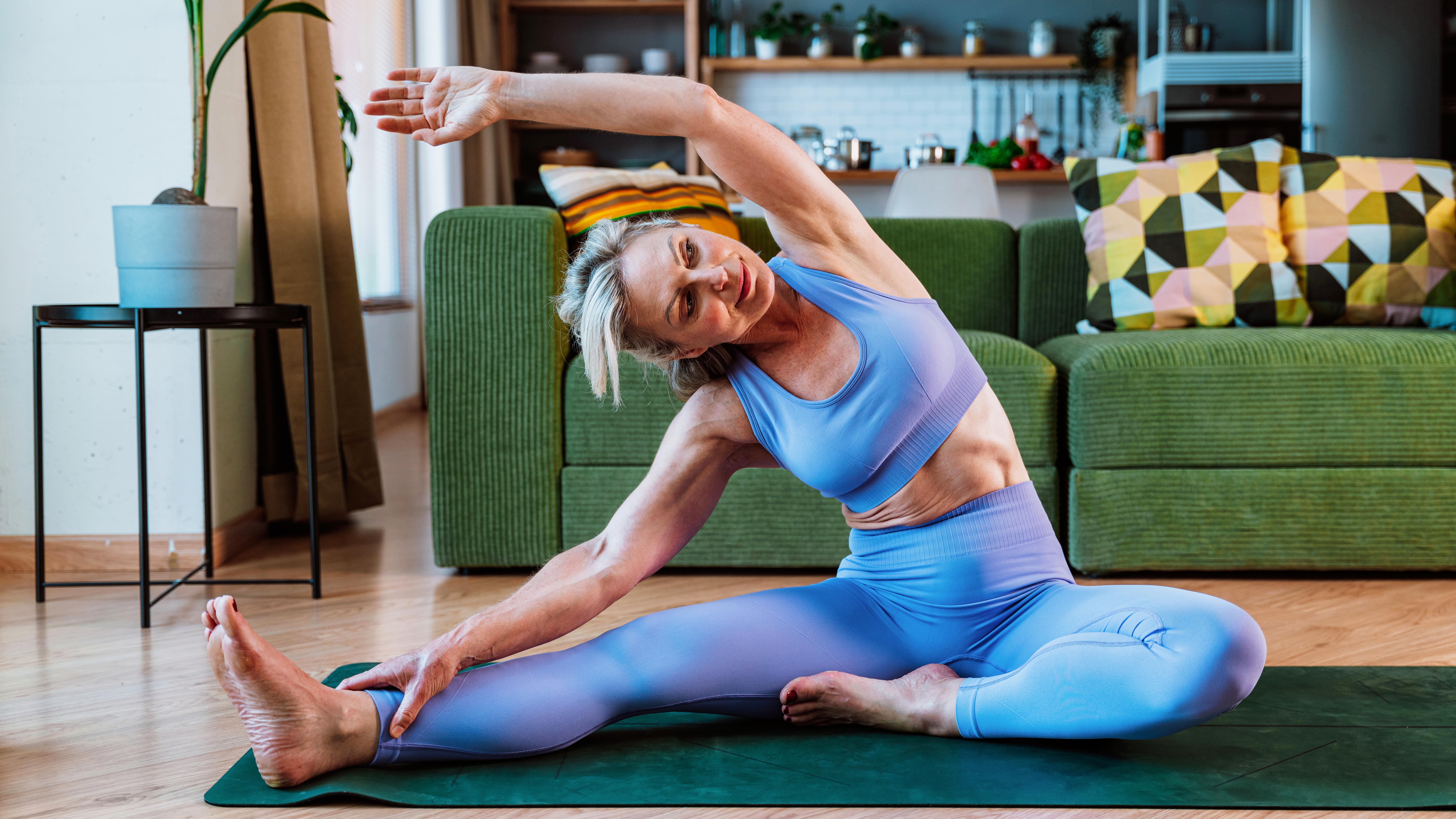
If your hips feel stiff when you get out of bed, tight after sitting for a while, or just generally less cooperative than they used to be — you're not alone. Hip mobility is one of the first things to decline after 50, and it affects far more than just your flexibility.
Tight, immobile hips contribute to lower back pain, knee problems, poor balance, difficulty walking, trouble getting up from chairs, and an increased risk of falls. They also limit how effectively you can exercise, reducing the benefits of squats, lunges, deadlifts, and even walking.
The good news? Hip mobility responds incredibly well to consistent, targeted work. Just 10–15 minutes a day can make a dramatic difference within a few weeks. Here are the five best exercises to open up, strengthen, and restore mobility to your hips after 50.
Why Your Hips Get Tight After 50
Before we get into the exercises, it helps to understand why this happens:
- Prolonged sitting — Modern life involves sitting for hours. This shortens your hip flexors and weakens your glutes, creating a muscular imbalance that restricts hip movement
- Natural cartilage changes — The cartilage in your hip joints gradually thins with age, reducing the smooth cushioning between bones
- Reduced synovial fluid — The lubricating fluid in your joints decreases, making movement feel stiffer and less comfortable
- Muscle loss (sarcopenia) — The muscles surrounding your hips weaken if not actively trained, reducing stability and range of motion
- Hormonal changes — Declining oestrogen after menopause can affect joint flexibility, connective tissue elasticity, and inflammation levels
The solution isn't to accept stiffness as inevitable — it's to move your hips through their full range of motion regularly.
1. Hip Circles (Standing)
The simplest exercise on this list, but don't underestimate it. Hip circles gently move your hip joints through their full range of motion, warming up the surrounding muscles and lubricating the joint with synovial fluid.
How to Do Them
- Stand with feet hip-width apart, hands on your hips
- Draw large, slow circles with your hips — imagine you're hula-hooping in slow motion
- Complete 10 circles in one direction, then reverse for 10 circles the other way
- Keep your upper body relatively still — the movement should come entirely from your hips
Why They Work
Hip circles activate every muscle group around the hip joint — flexors, extensors, abductors, adductors, and rotators. They're the perfect warm-up before any exercise and a brilliant standalone movement if you've been sitting for a long time. Many physiotherapists recommend them as the first exercise of the day.
Programming
- 10 circles each direction × 2–3 sets
- Do these every morning and before every workout
- Make the circles as large as your range allows — they'll naturally get bigger over time
2. The 90/90 Stretch
This is one of the most effective hip mobility exercises in existence. It simultaneously works on internal and external rotation of both hips — two movement patterns that most people completely neglect.
How to Do It
- Sit on the floor with both knees bent at 90-degree angles
- Your front leg should be in front of you with the knee bent at 90°, shin parallel to your body
- Your back leg should be beside you with the knee bent at 90°, shin pointing behind you
- Sit up tall, keeping your spine neutral
- Hold for 30–60 seconds, breathing deeply
- Switch sides
Why It Works
The 90/90 position puts your front hip into external rotation and your back hip into internal rotation simultaneously. Internal rotation is the most commonly restricted hip movement and is a major contributor to lower back pain, knee issues, and poor squat form. Restoring it can be genuinely life-changing.
Modifications
- Can't sit flat? Sit on a yoga block, folded towel, or cushion to elevate your hips. This reduces the demand on your hip rotation
- Back hip uncomfortable? Place a cushion under the back knee. Focus on the front hip and let the back hip gradually adapt
- Too easy? Lean your torso forward over the front shin while keeping your chest up. This dramatically deepens the stretch
Programming
- Hold 30–60 seconds each side × 2–3 sets
- Do this daily if possible — consistency matters more than duration
3. Pigeon Pose (Modified)
Pigeon pose is a yoga classic that targets your hip flexors, glutes, and piriformis — three muscles that become chronically tight from sitting. The modified version makes it accessible for all levels.
How to Do It
- Floor version: Start on all fours. Bring your right knee forward behind your right wrist. Extend your left leg straight behind you. Lower your hips toward the floor and hold
- Modified version (recommended for beginners): Use a chair or bed instead. Place your right shin across the seat of a sturdy chair, keeping your left foot on the ground. Gently lean forward from the hips until you feel a deep stretch in your right glute
Why It Works
Pigeon pose opens up the deep external rotators of the hip, including the piriformis — a small but powerful muscle that can cause significant pain and restriction when tight. It also stretches the hip flexor of the back leg, addressing the shortening caused by prolonged sitting.
Many women find that regular pigeon pose reduces or eliminates sciatic-type pain that radiates from the hip down the leg.
Programming
- Hold 45–90 seconds each side × 2 sets
- Breathe deeply and relax into the stretch — don't force it
- The modified chair version is just as effective and much more accessible
4. Hip Flexor Lunge Stretch
Get your FREE 7-Day Beginner Workout Plan
A gentle, progressive week of strength, cardio, flexibility and balance — designed just for women over 50. Pop in your details and I'll send it straight away. 💪
Your hip flexors (primarily the iliopsoas) are arguably the tightest muscles in most people over 50. They shorten from sitting and pull your pelvis into an anterior tilt, causing lower back pain, poor posture, and restricted hip extension.
How to Do It
- Kneel on your right knee (place a cushion under it for comfort)
- Step your left foot forward so your left knee is directly above your left ankle at 90°
- Keep your torso upright and gently shift your weight forward until you feel a deep stretch in the front of your right hip
- Squeeze your right glute — this intensifies the stretch and teaches your hip flexor to relax
- Hold for 30–60 seconds, then switch sides
Why It Works
This stretch directly targets the psoas and iliacus muscles (your deep hip flexors), which are almost impossible to stretch any other way. Releasing chronic hip flexor tightness can:
- Immediately reduce lower back pain
- Improve your posture (reduce that "duck bum" anterior pelvic tilt)
- Allow your glutes to fire properly (tight hip flexors inhibit glute activation)
- Improve your walking stride length and fluidity
Progressions
- Level 1: Basic kneeling lunge stretch (as described above)
- Level 2: Add an arm reach — raise the same-side arm (as the back knee) overhead and lean slightly away. This adds a stretch to the entire fascial chain
- Level 3: Elevate the back foot on a couch or chair behind you (couch stretch). This is intense but incredibly effective for stubborn hip flexors
Programming
- Hold 30–60 seconds each side × 2–3 sets
- Do this after every long period of sitting
5. Frog Stretch
The frog stretch targets your inner thighs (adductors) — muscles that rarely get stretched but play a huge role in hip mobility and pelvic stability.
How to Do It
- Start on all fours (hands and knees)
- Slowly widen your knees apart, keeping your feet in line with your knees (toes pointing outward)
- Lower your forearms to the floor (or onto a pillow)
- Gently rock your hips backward toward your heels until you feel a deep stretch along your inner thighs
- Hold for 30–60 seconds, breathing deeply
Why It Works
Tight adductors restrict your ability to open your hips, squat deeply, and move laterally. They're also a common contributor to groin pain and knee issues. The frog stretch is one of the most effective ways to release these muscles because it uses gravity and body position rather than forcing the stretch.
Modifications
- Too intense? Don't widen your knees as far. Start narrow and gradually increase the width as your flexibility improves
- Knee discomfort? Place a folded blanket or yoga mat under your knees for extra cushioning
- Want more? Gently rock forward and backward in the position. This dynamic movement often releases tightness faster than holding still
Programming
- Hold 30–60 seconds × 2–3 sets
- The gentle rocking variation is particularly effective — try 30 seconds of rocking followed by 30 seconds of holding
A 15-Minute Daily Hip Mobility Routine
Do this routine every morning, before a workout, or after a long day of sitting. Consistency is the key — 10 minutes daily beats 30 minutes once a week.
- Hip Circles: 10 each direction × 2 sets (2 minutes)
- 90/90 Stretch: 45 seconds each side × 2 sets (3 minutes)
- Pigeon Pose: 60 seconds each side × 2 sets (4 minutes)
- Hip Flexor Lunge: 45 seconds each side × 2 sets (3 minutes)
- Frog Stretch: 45 seconds × 2 sets (with gentle rocking) (3 minutes)
Total time: ~15 minutes. You'll feel the difference immediately, and within 2–3 weeks of daily practice, the cumulative improvement will be remarkable.
Tips for Better Results
- Warm up first — Do hip circles or a 2-minute walk before deep stretches. Cold muscles don't stretch as effectively
- Breathe into the stretch — Deep, slow breathing activates your parasympathetic nervous system, which tells your muscles to relax. Holding your breath creates tension
- Never force it — A good stretch should feel like a strong pull, not sharp pain. If it hurts, back off
- Consistency over intensity — 10 minutes every day will transform your hips faster than one 45-minute session per week
- Stand up every 30–45 minutes — If you sit for long periods, set a timer to stand, walk, and do a quick hip flexor stretch. This prevents the tightness from building up in the first place
- Strengthen what you stretch — Mobility without strength is unstable. Pair these stretches with hip-strengthening exercises like goblet squats, glute bridges, and lateral band walks for the best results
When to See a Professional
These exercises are safe for most people, but consult your GP or physiotherapist if you experience:
- Sharp, catching, or locking sensations in the hip joint
- Pain that radiates down your leg or into your groin
- Hip pain that wakes you at night
- Significant asymmetry (one hip much tighter or more painful than the other)
- Any pain that doesn't improve after 2–3 weeks of gentle mobility work
The Bottom Line
Your hips are the foundation of how you move through the world. When they're stiff and restricted, everything gets harder — walking, exercising, getting up from a chair, bending down, and even sleeping comfortably.
The brilliant thing about hip mobility is that it responds quickly to consistent work. Just 10–15 minutes a day of these five exercises will have you moving better, feeling less pain, and wondering why you didn't start sooner. Your future self will thank you. 🧡
Get your FREE 7-Day Beginner Workout Plan
A gentle, progressive week of strength, cardio, flexibility and balance — designed just for women over 50. Pop in your details and I'll send it straight away. 💪