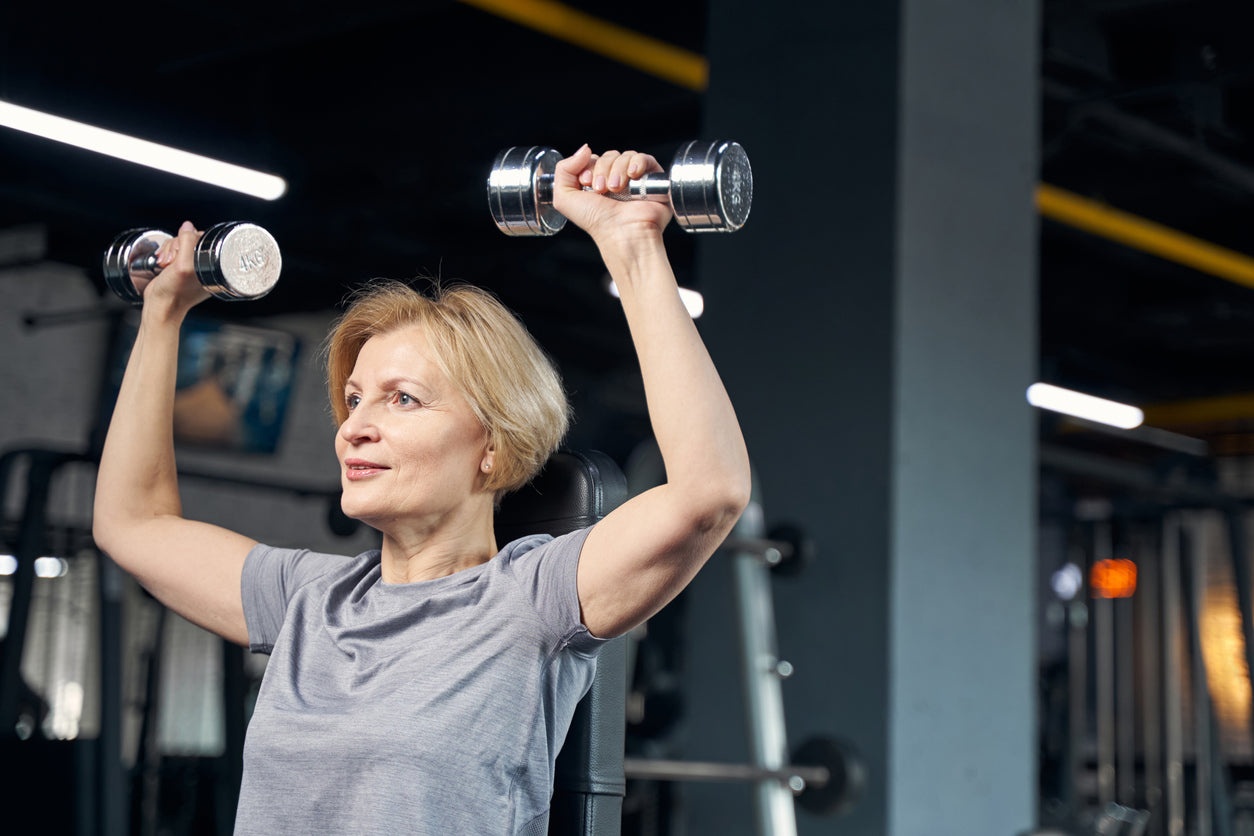
Let's be honest — most fitness advice for women over 50 focuses on legs, balance, and "gentle" movement. And while all of that matters, there's one area that gets criminally overlooked: your arms.
Strong arms aren't just about aesthetics (though feeling confident in a sleeveless top is a lovely bonus). They're about functional independence — carrying groceries, lifting grandkids, pushing yourself up from the floor, opening jars, and doing everyday tasks without pain or struggle.
The reality? After 50, we lose muscle mass at an accelerating rate — roughly 1–2% per year — and our upper body tends to lose it faster than our lower body. If you're not actively training your arms, you're losing strength you'll genuinely need.
Here are the five best exercises to build and maintain strong, functional arms after 50.
1. Bicep Curls
The classic for a reason. Bicep curls are simple, effective, and easy to scale from complete beginner to advanced.
How to Do Them
- Stand with feet hip-width apart, holding a dumbbell in each hand with palms facing forward
- Keep your elbows pinned to your sides — don't let them drift forward
- Curl the weights up toward your shoulders, squeezing at the top
- Lower slowly (3 seconds down) — the lowering phase is where the magic happens
Why They Matter After 50
Your biceps are the muscles you use every time you pick something up, carry bags, or pull a door open. Weak biceps make everyday tasks harder and increase your risk of elbow and shoulder strain. Strong biceps also support your shoulder joint, reducing injury risk.
Programming
- Beginner: 2–3 kg dumbbells, 3 sets of 10–12 reps
- Intermediate: 4–6 kg dumbbells, 3 sets of 10–12 reps
- Advanced: 7–10 kg dumbbells, 4 sets of 8–10 reps
Pro tip: Slow down the lowering phase to 3–4 seconds. This eccentric loading builds more muscle than fast, swingy reps.
2. Tricep Dips
The backs of your arms — your triceps — make up roughly two-thirds of your total arm size. If you want toned, strong arms, you absolutely cannot skip triceps. Dips are one of the most effective bodyweight exercises for targeting them.
How to Do Them
- Sit on the edge of a sturdy chair or bench, hands gripping the edge beside your hips
- Slide your hips off the edge, supporting your weight with your arms
- Bend your elbows to lower your body down (aim for a 90-degree bend)
- Push back up to straight arms, squeezing your triceps at the top
Why They Matter After 50
Triceps are essential for pushing movements — pushing yourself up from a chair, getting out of bed, pushing open heavy doors, and stabilising your arms during overhead activities. They also play a key role in shoulder health and posture.
Modifications
- Easier: Keep your feet closer to the chair and bend your knees. This reduces the load on your arms
- Harder: Extend your legs straight out in front of you, or elevate your feet on another chair
- Wrist issues? Try tricep kickbacks with a light dumbbell instead — same muscle, no wrist pressure
Programming
- Beginner: 3 sets of 6–8 reps (bent knees)
- Intermediate: 3 sets of 10–12 reps (legs extended)
- Advanced: 4 sets of 12–15 reps (feet elevated)
3. Overhead Press
The overhead press (also called shoulder press) is a compound movement that works your shoulders, triceps, and upper back simultaneously. It's one of the most functional exercises you can do because reaching overhead is something you do every single day.
How to Do Them
- Stand or sit with a dumbbell in each hand at shoulder height, palms facing forward
- Press the weights straight up overhead until your arms are fully extended
- Lower back to shoulder height with control
- Keep your core engaged throughout — don't arch your lower back
Why They Matter After 50
Reaching overhead becomes harder as we age due to shoulder mobility loss and muscle weakness. Training the overhead press keeps you able to put things on high shelves, hang washing on the line, lift suitcases into overhead compartments, and maintain shoulder joint health. It also strengthens the stabiliser muscles around your rotator cuff.
Programming
- Beginner: 2–3 kg dumbbells, 3 sets of 8–10 reps (seated for extra stability)
- Intermediate: 4–6 kg dumbbells, 3 sets of 10–12 reps (standing)
- Advanced: 7–10 kg dumbbells, 4 sets of 8–10 reps (standing)
Pro tip: If you have shoulder issues, try a neutral grip (palms facing each other) instead of palms forward. This is often much more comfortable and still very effective.
4. Hammer Curls
Get your FREE 7-Day Beginner Workout Plan
A gentle, progressive week of strength, cardio, flexibility and balance — designed just for women over 50. Pop in your details and I'll send it straight away. 💪
Hammer curls look similar to regular bicep curls, but your palms face inward (toward each other) instead of forward. This small change makes a big difference — it shifts the emphasis to your brachioradialis (the muscle running along the top of your forearm) and your brachialis (a deep arm muscle that pushes your bicep up and makes your whole arm look thicker).
How to Do Them
- Stand with feet hip-width apart, holding dumbbells with palms facing your thighs
- Keep your palms facing each other throughout the entire movement
- Curl the weights up toward your shoulders
- Lower with control — don't swing
Why They Matter After 50
Hammer curls build grip strength and forearm strength — two things that decline significantly with age and are strongly correlated with overall health and longevity. Research shows that grip strength is one of the best predictors of all-cause mortality in older adults. Plus, stronger forearms mean easier jar opening, firmer handshakes, and better ability to carry heavy bags.
Programming
- Beginner: 2–3 kg dumbbells, 3 sets of 10–12 reps
- Intermediate: 4–6 kg dumbbells, 3 sets of 10–12 reps
- Advanced: 7–10 kg dumbbells, 4 sets of 8–10 reps
Pro tip: Try alternating arms instead of curling both at once. This forces your core to stabilise and gives each arm a mini rest between reps.
5. Push-Ups (Modified)
Push-ups are the ultimate compound upper body exercise — they work your chest, shoulders, triceps, and core all at once. And no, you don't need to do them from the floor. Modified push-ups are just as effective for building strength when done properly.
How to Do Them
- Wall push-ups (beginner): Stand arm's length from a wall, place hands flat at shoulder height, and push away
- Incline push-ups (intermediate): Use a bench, kitchen counter, or sturdy table. The lower the surface, the harder it gets
- Knee push-ups (advanced beginner): On the floor, from your knees instead of toes
- Full push-ups (advanced): From toes, maintaining a straight line from head to heels
Why They Matter After 50
Push-ups build pushing strength that you use constantly — getting up from the floor, pushing yourself out of bed, catching yourself if you stumble. A 2019 study found that adults who could complete more push-ups had a significantly lower risk of cardiovascular events. They also build chest and shoulder strength, which supports better posture.
Programming
- Wall push-ups: 3 sets of 12–15 reps
- Incline push-ups: 3 sets of 8–12 reps
- Knee push-ups: 3 sets of 8–10 reps
- Full push-ups: 3 sets of 6–10 reps
Progression plan: Start wherever you need to (no shame in wall push-ups!) and aim to move to the next level every 3–4 weeks. The goal is consistent progress, not perfection.
A Simple Arm Workout to Get Started
Here's a complete arm workout you can do 2–3 times per week. It takes about 20 minutes and requires just a pair of dumbbells and a chair.
- Warm-up: 2 minutes of arm circles and light shadow boxing
- Bicep Curls: 3 sets of 10–12 reps
- Tricep Dips: 3 sets of 8–10 reps
- Overhead Press: 3 sets of 8–10 reps
- Hammer Curls: 3 sets of 10–12 reps
- Push-Ups (your level): 3 sets to near-failure
- Cool-down: 2 minutes of gentle arm and shoulder stretches
Rest 60–90 seconds between sets. Choose a weight that makes the last 2–3 reps genuinely challenging — if you can breeze through all 12 reps, go heavier next time.
How to Progress
Your arms will adapt quickly if you train them consistently. Here's how to keep progressing:
- Increase weight gradually — go up by 0.5–1 kg when your current weight feels comfortable for all sets
- Slow down the tempo — a 3-second lower on every rep dramatically increases time under tension
- Add a pause — hold the squeeze at the top of each curl for 2 seconds
- Increase sets or reps — add one extra set or 2 extra reps per exercise every 2 weeks
- Train to near-failure — your last 2–3 reps should feel genuinely hard. If they don't, increase the challenge
Common Mistakes to Avoid
- Swinging the weights — If you have to swing or use momentum, the weight is too heavy. Drop down and do it properly
- Going too light — Those 1 kg pink dumbbells aren't doing anything for you. You need to challenge your muscles to make them grow. Don't be afraid to go heavier
- Skipping triceps — Most people focus on biceps and ignore triceps. Your triceps are 2/3 of your arm — train them!
- Holding your breath — Breathe out on the effort (the curl up or press up) and in on the way down
- Rushing through reps — Slow, controlled reps build more muscle than fast, sloppy ones. Quality over quantity, always
The Bottom Line
Strong arms aren't a vanity project — they're a quality of life project. Every time you carry a shopping bag, lift a grandchild, push yourself up from the couch, or reach for something on a high shelf, your arm strength matters.
The best part? Arms respond to training quickly. Within 4–6 weeks of consistent training, you'll notice real changes in both how you look and how you feel. Those sleeveless tops? You'll reach for them with confidence. 💪
Get your FREE 7-Day Beginner Workout Plan
A gentle, progressive week of strength, cardio, flexibility and balance — designed just for women over 50. Pop in your details and I'll send it straight away. 💪