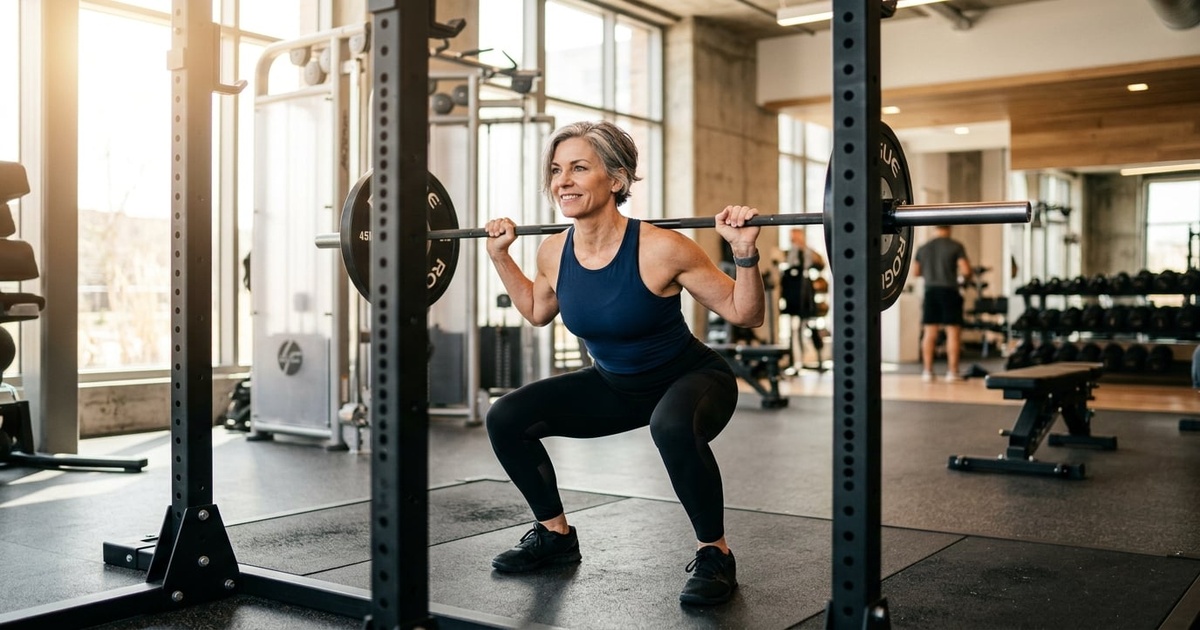
Your legs are the foundation of everything you do — walking, climbing stairs, getting up from a chair, carrying shopping bags, playing with grandkids, and simply staying independent as you age. Yet after 50, leg strength is one of the first things to decline if you're not actively training it.
Here's the reality: we lose roughly 1–2% of muscle mass per year after 50, and our lower body bears the brunt. Weaker legs mean a higher risk of falls, joint pain, reduced mobility, and loss of independence. The good news? It's completely reversible with the right exercises.
These five exercises are the most effective, safest, and most functional leg movements for women over 50. No gym membership required — you can do most of them at home with minimal equipment.
1. Goblet Squats
The goblet squat is the single best leg exercise you can do after 50. It trains your quads, glutes, hamstrings, and core all at once — and the front-loaded weight actually helps you stay upright and maintain better form than a traditional barbell squat.
How to Do Them
- Hold a dumbbell or kettlebell close to your chest with both hands, elbows pointing down
- Stand with feet slightly wider than hip-width apart, toes turned out about 15–30 degrees
- Push your hips back and bend your knees to lower yourself — imagine sitting into a chair
- Go as low as you comfortably can while keeping your chest up and heels on the floor
- Drive through your heels to stand back up, squeezing your glutes at the top
Why They Matter After 50
Squatting is a fundamental human movement pattern. Every time you sit down, stand up, pick something off the floor, or get in and out of a car, you're squatting. Losing the ability to squat comfortably is one of the earliest signs of functional decline. Goblet squats rebuild and maintain this essential movement pattern safely.
Programming
- Beginner: Bodyweight only or 4–6 kg dumbbell, 3 sets of 10–12 reps
- Intermediate: 8–12 kg dumbbell or kettlebell, 3 sets of 10–12 reps
- Advanced: 14–20 kg kettlebell, 4 sets of 8–10 reps
Pro tip: If you struggle with depth, place a chair or bench behind you and squat down until your glutes just touch it, then stand back up. This gives you a target and builds confidence.
2. Romanian Deadlifts (RDLs)
Romanian deadlifts target your posterior chain — hamstrings, glutes, and lower back — the muscles that keep you upright, protect your spine, and power every step you take. Most women over 50 are weaker in their posterior chain than their quads, which creates imbalances and increases injury risk.
How to Do Them
- Stand with feet hip-width apart, holding a dumbbell in each hand in front of your thighs
- With a slight bend in your knees (keep them soft, not locked), hinge forward at the hips
- Push your hips backward as you lower the weights along your legs — keep them close to your body
- Lower until you feel a strong stretch in your hamstrings (typically mid-shin level)
- Squeeze your glutes and drive your hips forward to return to standing
Why They Matter After 50
The hip hinge is how you safely pick things up from the floor, bend over the sink, unload the dishwasher, and garden. Weak hamstrings and glutes are a leading cause of lower back pain in women over 50. RDLs strengthen exactly the muscles that protect your back and keep you moving pain-free.
Programming
- Beginner: 3–5 kg dumbbells, 3 sets of 10–12 reps
- Intermediate: 6–10 kg dumbbells, 3 sets of 10–12 reps
- Advanced: 12–16 kg dumbbells, 4 sets of 8–10 reps
Pro tip: Keep your back flat throughout the movement — imagine balancing a glass of water on your lower back. If your back starts rounding, you've gone too low.
3. Step-Ups
Step-ups are one of the most functional exercises you can do. They directly mimic climbing stairs, stepping over obstacles, and getting into vehicles — all movements that become harder without targeted training after 50.
How to Do Them
- Stand facing a sturdy step, bench, or box (start with a low step — 15–20 cm is plenty)
- Place your entire right foot firmly on the step
- Drive through your right heel to step up, bringing your left foot to meet it
- Step back down with your left foot, then your right
- Complete all reps on one side, then switch — this ensures each leg does equal work
Why They Matter After 50
Step-ups build single-leg strength, balance, and coordination — three things that decline rapidly after 50 and directly contribute to falls. They also strengthen the muscles around your knees and hips, which helps reduce joint pain and stiffness. If you can comfortably step up onto a 30 cm box, you'll handle stairs, kerbs, and uneven ground with confidence.
Programming
- Beginner: Bodyweight only, low step (15 cm), 3 sets of 8–10 per leg
- Intermediate: Holding 3–5 kg dumbbells, medium step (20–25 cm), 3 sets of 10 per leg
- Advanced: Holding 6–10 kg dumbbells, higher step (30 cm), 3 sets of 12 per leg
Pro tip: Hold onto a wall or railing for balance when you're starting out. As you get stronger, try doing them without support — this builds your stabiliser muscles and improves proprioception.
4. Wall Sits
Get your FREE 7-Day Beginner Workout Plan
A gentle, progressive week of strength, cardio, flexibility and balance — designed just for women over 50. Pop in your details and I'll send it straight away. 💪
Wall sits are a brilliant isometric exercise — meaning your muscles work hard without moving. They build incredible quad endurance and knee stability, and they're completely joint-friendly because there's no impact and no complex movement pattern to learn.
How to Do Them
- Stand with your back flat against a wall, feet about 60 cm from the wall
- Slide down the wall until your thighs are roughly parallel to the floor (or as low as comfortable)
- Keep your back pressed firmly against the wall, knees directly above your ankles
- Hold this position — your quads will start burning, and that's exactly the point
- Slide back up when you can't hold any longer
Why They Matter After 50
Wall sits strengthen the quadriceps and the muscles around your knees without putting any impact stress on the joints. This makes them perfect for women with knee pain, arthritis, or joint sensitivity. Strong quads are essential for walking, standing from a seated position, and maintaining knee health long-term. They're also proven to help lower blood pressure — a common concern after 50.
Programming
- Beginner: 3 holds of 15–20 seconds, with 30 seconds rest between
- Intermediate: 3 holds of 30–45 seconds
- Advanced: 3 holds of 60+ seconds (or add a light dumbbell on your lap)
Pro tip: If full parallel is too intense, don't slide as low. A quarter-squat position against the wall is still excellent for building strength and is much easier on your knees.
5. Glute Bridges
Glute bridges target your glutes, hamstrings, and core — the powerhouse muscles that support your pelvis, protect your lower back, and keep you strong through every movement. They're also incredibly gentle on your joints, making them ideal for all fitness levels.
How to Do Them
- Lie on your back with knees bent, feet flat on the floor about hip-width apart
- Arms flat at your sides, palms down
- Push through your heels to lift your hips toward the ceiling
- Squeeze your glutes hard at the top — your body should form a straight line from shoulders to knees
- Hold for 2–3 seconds, then lower slowly back down
Why They Matter After 50
Weak glutes are the hidden cause behind an enormous number of problems in women over 50 — lower back pain, hip pain, knee pain, poor posture, and difficulty walking. Your glutes are the largest muscle group in your body, and when they're weak, everything else compensates and breaks down. Glute bridges activate and strengthen these muscles in a safe, controlled position.
Programming
- Beginner: Bodyweight, 3 sets of 12–15 reps with 2-second hold at top
- Intermediate: Place a resistance band above your knees, 3 sets of 12–15 reps
- Advanced: Place a dumbbell or weight plate on your hips, 3 sets of 10–12 reps
Pro tip: Try single-leg glute bridges once you've mastered the basic version. Extend one leg straight out and bridge with the other — this doubles the load on each glute and builds impressive single-leg stability.
Your 20-Minute Stronger Legs Workout
Here's a complete workout you can do 2–3 times per week. All you need is a pair of dumbbells and a wall.
| Exercise | Sets | Reps / Time | Rest |
|---|---|---|---|
| Goblet Squats | 3 | 10–12 reps | 60 sec |
| Romanian Deadlifts | 3 | 10–12 reps | 60 sec |
| Step-Ups (each leg) | 3 | 8–10 reps | 45 sec |
| Wall Sits | 3 | 20–45 sec hold | 30 sec |
| Glute Bridges | 3 | 12–15 reps | 45 sec |
Warm-up: 3–5 minutes of walking or gentle marching on the spot, plus some bodyweight squats and leg swings.
Cool-down: 3–5 minutes of gentle stretching — quad stretch, hamstring stretch, calf stretch, and hip flexor stretch.
Why Leg Strength Is Non-Negotiable After 50
Here's what the research tells us:
- Fall prevention: Stronger legs are the single biggest factor in preventing falls — the leading cause of injury in adults over 50
- Bone density: Weight-bearing leg exercises stimulate bone growth in the hips and spine, reducing osteoporosis risk
- Metabolism: Your legs contain the largest muscles in your body — stronger legs means a faster resting metabolism and easier weight management
- Independence: The ability to stand from a chair without using your hands, climb stairs, and walk confidently is directly tied to leg strength
- Joint health: Strong muscles around the knees and hips absorb impact and reduce joint pain
The women who stay active, independent, and confident in their 60s, 70s, and beyond are the ones who prioritise their legs now.
Final Thoughts
You don't need a gym, you don't need heavy weights, and you don't need hours of training. Just 20 minutes, 2–3 times per week, with these five exercises will transform your leg strength, balance, and confidence.
Start where you are. Use the beginner modifications if you need them. Progress when you're ready. The most important thing is that you start — and stay consistent.
Your future self will thank you for every squat, every step-up, and every bridge you do today. 💪
Get your FREE 7-Day Beginner Workout Plan
A gentle, progressive week of strength, cardio, flexibility and balance — designed just for women over 50. Pop in your details and I'll send it straight away. 💪