If there's one muscle group that deserves more attention after 50, it's your glutes. And no, this isn't about aesthetics (although a lifted, toned backside is a lovely bonus 💛). Your glutes are the largest and most powerful muscle group in your body — and they're responsible for far more than you might think.
Strong glutes keep your hips stable, protect your lower back, improve your balance, help you walk with confidence and even reduce knee pain. The problem? After decades of sitting at desks, in cars and on sofas, most women over 50 have glutes that are weak, underactive and essentially "asleep." Physiotherapists even have a name for it: gluteal amnesia (yes, your bum literally forgets how to work!).
The good news is that your glutes respond beautifully to targeted exercise — at any age. These five exercises are specifically chosen because they're safe, effective and easy to do at home with no equipment. Let's wake those glutes up.
Why Glute Strength Matters More After 50
Your glutes are made up of three muscles — the gluteus maximus (the big one), gluteus medius (on the side) and gluteus minimus (the deepest layer). Together, they're responsible for:
- Hip extension — standing up from a chair, climbing stairs, walking uphill
- Hip stabilisation — keeping your pelvis level when you walk (weak glutes cause that side-to-side wobble)
- Lower back protection — when your glutes are weak, your lower back compensates and takes the strain
- Knee alignment — strong glute med keeps your knees tracking properly, reducing pain and injury risk
- Balance and fall prevention — your glutes are essential for catching yourself when you stumble
After 50, women lose muscle mass at roughly 1–2% per year without targeted training. Your glutes are often the first to weaken because modern life involves so much sitting. But the research is clear: women of any age can rebuild glute strength with consistent, targeted exercise. You just need the right moves.
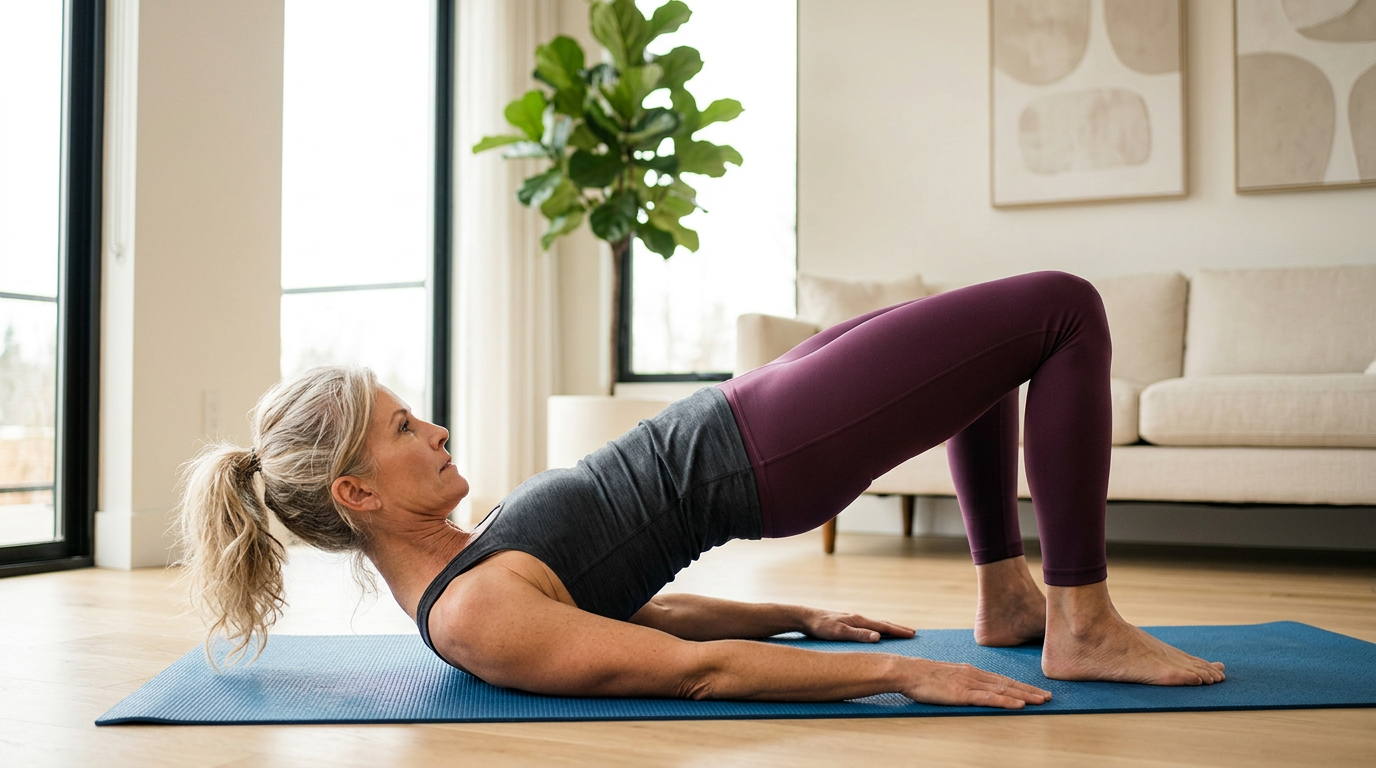
1. Glute Bridge
The glute bridge is the gold standard for activating sleepy glutes. It's gentle on your knees and back while delivering a powerful contraction right where you need it.
How to Do It
- Lie on your back with knees bent, feet flat on the floor hip-width apart
- Press through your heels and squeeze your glutes to lift your hips toward the ceiling
- Hold at the top for 2–3 seconds — really squeeze those glutes
- Lower slowly back down with control
- Do: 3 sets of 12 reps
Make it easier: Place your feet slightly further from your body if you feel it in your thighs rather than your glutes.
Make it harder: Try single-leg glute bridges — extend one leg straight, keeping hips level as you lift.
Why it works: Glute bridges isolate your gluteus maximus with minimal joint stress. They also strengthen your hamstrings and teach your glutes to "switch on" — which carries over into every other movement you do.
2. Standing Kickback (Using a Chair)
This exercise targets your gluteus maximus through hip extension while also challenging your balance and core stability. It's a fantastic functional exercise because it mimics the movement pattern you use when walking and climbing stairs.
How to Do It
- Stand behind a sturdy chair, holding the back for support
- Keeping your standing leg slightly bent, extend one leg straight back behind you
- Squeeze your glute at the top — don't arch your lower back
- Return slowly with control
- Do: 3 sets of 12 reps each side
Key tip: Keep your torso upright and resist the urge to lean forward. The movement should come entirely from your hip, not your back. Think "squeeze the glute" rather than "kick the leg."
Why it works: Standing kickbacks build glute strength in a functional, upright position that transfers directly to walking, stair climbing and getting up from low surfaces.
3. Clamshell
The clamshell is a physio favourite for a reason — it targets your gluteus medius, the muscle on the side of your hip that most women over 50 desperately need to strengthen. Weak glute med is behind a huge number of hip, knee and lower back problems.
How to Do It
- Lie on your side with knees bent at about 45 degrees, feet together
- Keeping your feet touching, open your top knee like a clamshell
- Lift only as high as you can without rolling your hips backward
- Hold for 1–2 seconds at the top, then lower slowly
- Do: 3 sets of 15 reps each side
Make it harder: Loop a light resistance band just above your knees for extra challenge.
Why it works: The clamshell isolates your gluteus medius, which is critical for hip stability, single-leg balance (like when you walk) and protecting your knees from inward collapse. It's also one of the most commonly prescribed exercises by physiotherapists for hip and knee pain.
4. Step-Up
Get your FREE 7-Day Beginner Workout Plan
A gentle, progressive week of strength, cardio, flexibility and balance — designed just for women over 50. Pop in your details and I'll send it straight away. 💪
Step-ups are one of the most functional glute exercises you can do because they directly mimic climbing stairs — something you do every single day. They build strength in your glutes, quads and hamstrings while improving balance and coordination.
How to Do It
- Stand in front of a sturdy step, stair or low bench (15–20cm high to start)
- Place your entire right foot firmly on the step
- Press through your heel and squeeze your glute to step up, bringing your left foot to meet your right
- Step back down slowly, leading with the left foot
- Do: 3 sets of 10 reps each side
Key tip: Resist the urge to push off your bottom foot — let the leg on the step do all the work. This ensures your glute is doing the lifting, not your calf.
Make it harder: Hold light dumbbells at your sides, or use a higher step as you get stronger.
Why it works: Step-ups are unilateral (one leg at a time), which means they expose and correct any strength imbalances between your left and right sides. They also build the practical glute and leg strength you need for stairs, hills and uneven ground.
5. Sumo Squat
The sumo squat (also called a wide-stance squat) shifts the emphasis from your quads to your glutes and inner thighs. It's a brilliant variation for women over 50 because the wider stance feels more stable and is often easier on the knees than a regular squat.
How to Do It
- Stand with feet wider than shoulder-width apart, toes pointed outward at about 45 degrees
- Clasp your hands in front of your chest or hold a light weight
- Push your hips back and bend your knees, lowering until your thighs are roughly parallel to the floor (or as low as comfortable)
- Press through your heels and squeeze your glutes to stand back up
- Do: 3 sets of 12 reps
Key tip: Keep your chest lifted and your knees tracking over your toes — don't let them cave inward. If balance is a concern, stand near a wall or doorframe for support.
Why it works: The wide stance and turned-out toes create a deeper glute stretch at the bottom of the movement and more glute activation as you push back up. It also works your inner thighs and improves hip mobility — both of which tend to tighten with age.
Your Glute Workout at a Glance
Here's the complete workout you can do 2–3 times per week:
| Exercise | Sets × Reps | Primary Target |
|---|---|---|
| Glute Bridge | 3 × 12 | Gluteus Maximus |
| Standing Kickback | 3 × 12 each side | Gluteus Maximus |
| Clamshell | 3 × 15 each side | Gluteus Medius |
| Step-Up | 3 × 10 each side | Glutes + Quads |
| Sumo Squat | 3 × 12 | Glutes + Inner Thighs |
This should take about 20–25 minutes, including short rests between sets. It's the perfect complement to your other workouts and can be done on its own or added to a leg day.
Tips for Getting the Most Out of Your Glute Training
- Squeeze at the top: The most important part of every glute exercise is the squeeze at the top of the movement. If you're not feeling it in your glutes, slow down and really focus on that contraction.
- Mind-muscle connection: Before each set, place your hand on your glute and think about contracting it. This simple trick dramatically improves activation.
- Warm up first: A 5-minute walk or gentle march on the spot prepares your hips and gets blood flowing to the muscles.
- Progress gradually: Start with bodyweight only. Once 3 sets feel comfortable, add a resistance band or light ankle weights.
- Consistency over intensity: Three 20-minute sessions per week will deliver far better results than one hard session followed by a week off.
- Don't sit too long: Even the best glute workout can't fully counteract 10 hours of sitting. Set a timer to stand and move every 30–45 minutes during the day.
When Will You See Results?
Most women notice their glutes "switching on" within the first 1–2 weeks — you'll feel them working during daily activities like climbing stairs and getting up from a chair. Visible changes in tone and shape typically appear within 6–8 weeks of consistent training (2–3 times per week).
More importantly, you'll likely notice improvements in lower back comfort, hip mobility and general confidence on your feet well before you see physical changes in the mirror. That's your glutes doing their job properly — often for the first time in years.
The Bottom Line (Pun Intended 😄)
Your glutes aren't just about how you look — they're about how you move, feel and function every single day. Strong glutes mean less back pain, steadier balance, healthier knees and the confidence to walk, climb and move freely for decades to come.
These five exercises are simple, effective and completely doable at home in under 25 minutes. No gym membership required, no complicated equipment — just you, a chair and a yoga mat.
Start today. Your glutes (and your back, hips and knees) will thank you. 💛
Get your FREE 7-Day Beginner Workout Plan
A gentle, progressive week of strength, cardio, flexibility and balance — designed just for women over 50. Pop in your details and I'll send it straight away. 💪