If you've ever groaned when standing up from a chair, felt stiffness after sitting too long, or noticed that your stride has shortened over the years — your hips are trying to tell you something.
The hip joint is the largest ball-and-socket joint in your body, and it's involved in virtually every movement you make — walking, climbing stairs, bending down, even just standing upright. After 50, the muscles surrounding this crucial joint can weaken and tighten, leading to pain, reduced mobility, and increased fall risk.
But here's the encouraging news: hip exercises are incredibly effective at any age. Research shows that targeted hip strengthening can reduce hip pain by up to 50% and significantly improve walking speed and stability. These five exercises require no equipment and can be done in your living room.
Why Hip Health Matters After 50
Your hips are the foundation of your movement system:
- They support your body weight — every step you take places 1.5–3 times your body weight through your hip joints
- They connect upper and lower body — weak hips affect your knees, lower back, and even your shoulders
- They influence balance — the hip abductor muscles are critical for preventing falls
- They deteriorate without use — sitting for long periods causes hip flexors to shorten and glutes to weaken, creating a cycle of tightness and pain
1. Standing Hip Circles
This gentle mobilisation exercise warms up the hip joint and improves range of motion in all directions.
How to do it:
- Stand tall with feet hip-width apart, holding a chair or wall for balance if needed
- Shift your weight onto your left leg
- Lift your right knee to hip height
- Slowly draw large circles with your knee — forward, out to the side, back, and around
- Complete 8 circles in one direction, then reverse for 8 more
- Switch legs and repeat
Why it works: Hip circles lubricate the joint with synovial fluid, reducing stiffness and improving the full range of motion your hip is capable of. Think of it as oiling a creaky hinge.
2. Clamshells
Clamshells target the gluteus medius — the hip abductor muscle that's critical for stability and preventing that "wobbly" feeling when walking.
How to do it:
- Lie on your side with knees bent at 45 degrees and feet together
- Keep your core engaged and hips stacked (don't roll backward)
- Slowly lift your top knee as high as you can without moving your pelvis
- Hold for 2 seconds at the top
- Lower slowly back down
- Complete 12–15 repetitions, then switch sides
Why it works: The gluteus medius is one of the most neglected muscles after 50, yet it's essential for single-leg stability — which you use every time you take a step. Weak glute med muscles are linked to knee pain, hip pain, and falls.
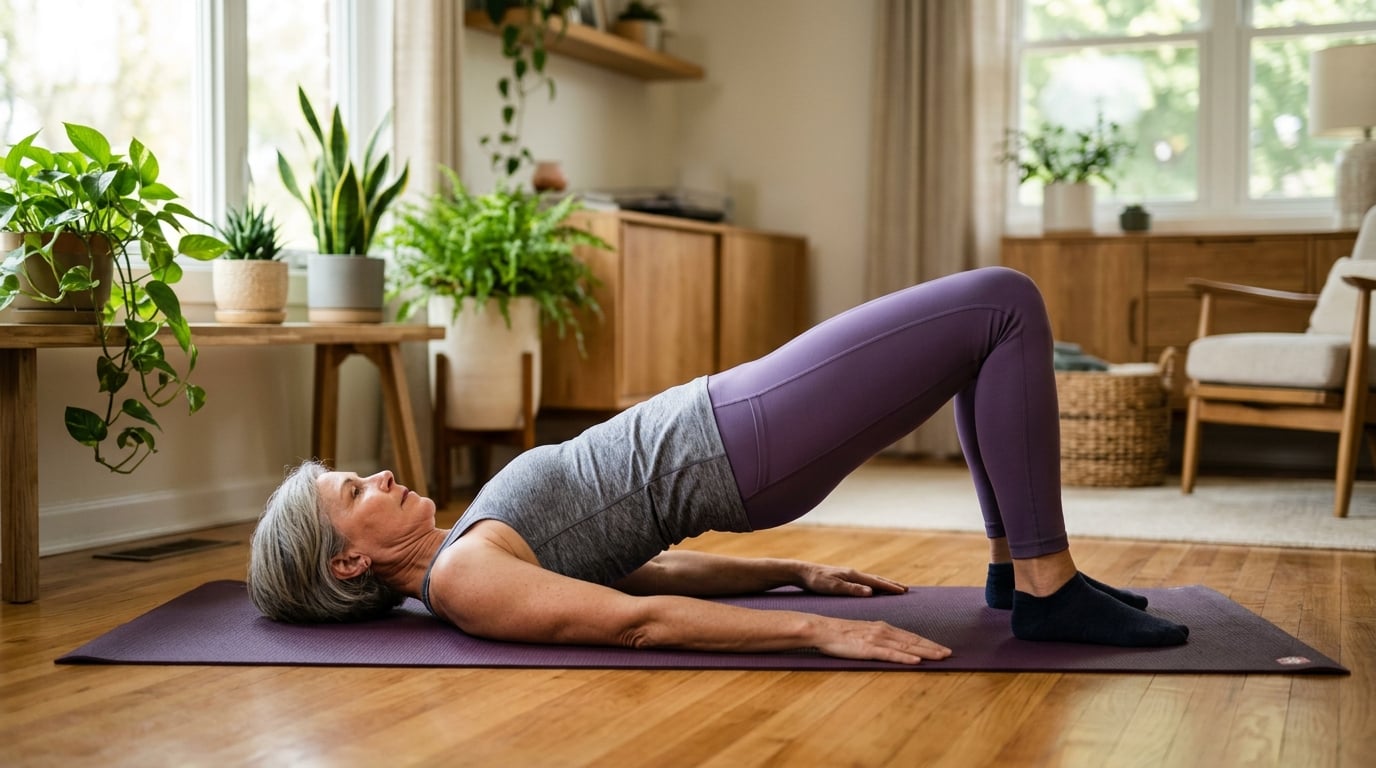
3. Hip Bridges
Get your FREE 7-Day Beginner Workout Plan
A gentle, progressive week of strength, cardio, flexibility and balance — designed just for women over 50. Pop in your details and I'll send it straight away. 💪
The hip bridge is a powerhouse exercise that strengthens your glutes, hamstrings, and lower back while gently stretching your hip flexors.
How to do it:
- Lie on your back with knees bent and feet flat on the floor, hip-width apart
- Press through your heels and squeeze your glutes to lift your hips toward the ceiling
- Create a straight line from your shoulders to your knees
- Hold for 3–5 seconds, squeezing your glutes at the top
- Lower slowly, one vertebra at a time
- Complete 12–15 repetitions
Why it works: Hip bridges counteract the effects of prolonged sitting by activating your glutes (which "switch off" when we sit) and lengthening your hip flexors. They also strengthen the posterior chain, which supports your lower back.
4. Standing Hip Abduction
This exercise strengthens the outer hip muscles that keep you stable when walking, climbing stairs, or standing on one leg.
How to do it:
- Stand tall holding a chair or wall for support
- Keep both legs straight and your body upright (don't lean)
- Slowly lift your right leg out to the side, about 30–45 degrees
- Keep your toes pointing forward (not up)
- Hold for 2 seconds, then lower slowly
- Complete 12 repetitions per side
Why it works: Hip abduction directly targets the muscles that prevent your pelvis from dropping when you walk — a common cause of that shuffling gait pattern. Strengthening these muscles improves walking confidence and reduces fall risk.
5. Figure-Four Stretch
This stretch targets the deep external rotators of the hip, including the piriformis — a muscle that, when tight, can cause sciatica-like pain down the leg.
How to do it:
- Lie on your back with both knees bent
- Cross your right ankle over your left knee, creating a figure-four shape
- Gently pull your left thigh toward your chest
- You should feel a deep stretch in your right hip and buttock
- Hold for 30–45 seconds, breathing deeply
- Switch sides and repeat
Why it works: Tight hip rotators are extremely common after 50 and can cause referred pain in the lower back, buttocks, and even down the leg. Regular stretching of these muscles reduces tension and improves hip mobility.
Your Weekly Hip Exercise Routine
For best results, aim for this routine 3–4 times per week:
- Warm up: Hip Circles — 8 each direction, each leg
- Strengthen: Clamshells (12–15 each side), Hip Bridges (12–15 reps), Standing Hip Abduction (12 each side)
- Stretch: Figure-Four Stretch — 30–45 seconds each side
- Total time: 10–15 minutes
Your hips carry you through life — literally. Investing just 10–15 minutes a few times a week in these exercises can mean the difference between moving freely or struggling with stiffness and pain. Start today, start gently, and let your hips thank you. 💪
Get your FREE 7-Day Beginner Workout Plan
A gentle, progressive week of strength, cardio, flexibility and balance — designed just for women over 50. Pop in your details and I'll send it straight away. 💪