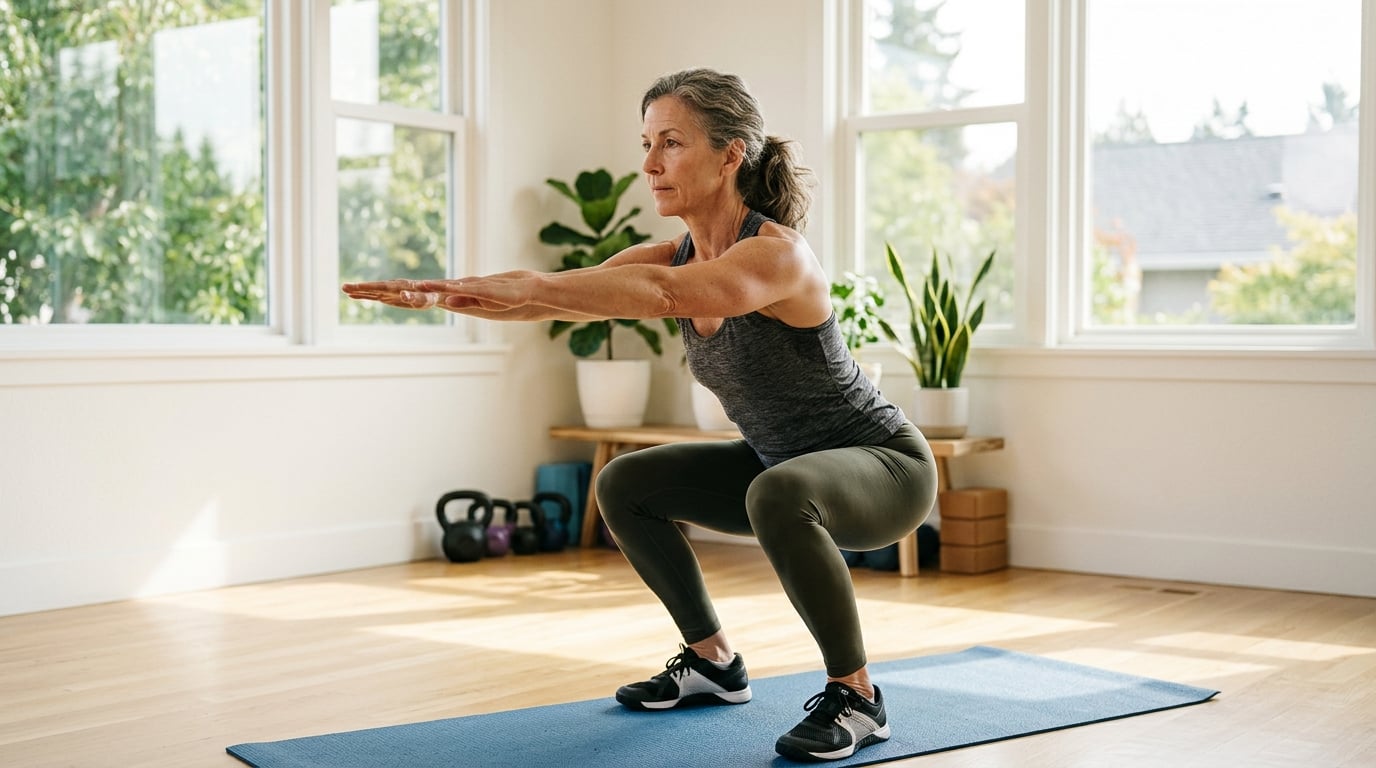
Your legs carry you through every single day — literally. From getting out of bed to climbing stairs, walking the dog, carrying groceries, and gardening, leg strength is the single biggest predictor of independence as we age.
After 50, we naturally lose muscle mass at a rate of 1–2% per year if we don't actively work to maintain it. And because our legs contain the largest muscles in our body, they're where this loss is felt most dramatically. The good news? Leg muscles respond exceptionally well to training at any age. Research shows that women over 50 can increase leg strength by 30–50% within 12 weeks of targeted exercise.
These five exercises target the major muscle groups of your lower body — quadriceps, hamstrings, glutes, and calves — giving you a complete leg workout in just 15–20 minutes.
Why Leg Strength Matters After 50
Your legs do far more than just walk you around:
- Fall prevention — strong leg muscles are your primary defence against falls, the leading cause of injury for adults over 50
- Joint protection — the muscles around your knees and hips act as shock absorbers, protecting your joints from wear and pain
- Bone density — weight-bearing leg exercises are the most effective way to maintain bone density in the hips and spine
- Metabolism — your legs contain the largest muscles in your body, so strengthening them has the biggest impact on your resting metabolic rate
- Daily independence — standing up from a chair, climbing stairs, getting in and out of the car, bending down to pick things up — it all requires leg strength
1. Bodyweight Squats
The squat is often called the king of exercises — and for good reason. It targets your quadriceps, hamstrings, glutes, and core simultaneously, making it the most functional lower body exercise you can do.
How to do it:
- Stand with feet shoulder-width apart, toes pointing slightly outward
- Hold your arms out in front for balance, or place hands on hips
- Push your hips back as if sitting into a chair
- Lower until your thighs are parallel to the floor (or as low as comfortable)
- Keep your chest lifted, back straight, and knees tracking over your toes
- Press through your heels to stand back up
- Complete 12–15 repetitions for 2–3 sets
Why it works: Squats mimic the exact movement pattern you use dozens of times a day — sitting down and standing up. Strengthening this pattern directly improves your ability to get out of chairs, use the toilet independently, and get in and out of cars without assistance.
Modification: If a full squat feels too challenging, do chair squats — lower yourself toward a chair, lightly touch the seat, then stand back up.
2. Step-Ups
Step-ups build single-leg strength and balance — critical skills for stair climbing and navigating uneven terrain.
How to do it:
- Stand in front of a sturdy step, bench, or the bottom stair
- Place your right foot firmly on the step
- Press through your right heel to step up, bringing your left foot to meet the right
- Step back down with the left foot, then the right
- Keep your torso upright throughout — don't lean forward
- Complete 10–12 repetitions per leg for 2–3 sets
Why it works: Step-ups train each leg independently, which exposes and corrects strength imbalances. They directly mimic stair climbing — one of the most common activities that becomes difficult with weak legs. Strengthening this movement builds real-world confidence.
3. Standing Calf Raises
Get your FREE 7-Day Beginner Workout Plan
A gentle, progressive week of strength, cardio, flexibility and balance — designed just for women over 50. Pop in your details and I'll send it straight away. 💪
Your calves are the unsung heroes of lower leg stability. They power every step you take and play a crucial role in balance and circulation.
How to do it:
- Stand near a wall or chair for light support
- Place feet hip-width apart
- Slowly rise up onto your tiptoes, lifting your heels as high as possible
- Hold at the top for 2–3 seconds, squeezing your calves
- Slowly lower back down
- Complete 15–20 repetitions for 2–3 sets
Why it works: Strong calves improve your push-off power when walking, help maintain balance on uneven surfaces, and support healthy circulation in your lower legs. Weak calves contribute to foot fatigue, ankle instability, and a shuffling gait pattern.
4. Reverse Lunges
Reverse lunges are the knee-friendly alternative to forward lunges. By stepping backward instead of forward, you reduce the shearing force on your knees while still getting an incredible leg workout.
How to do it:
- Stand tall with feet hip-width apart
- Step your right foot backward about 60–70cm
- Lower your back knee toward the floor, stopping when it's about 5cm from the ground
- Keep your front knee directly over your ankle (not past your toes)
- Press through your front heel to return to standing
- Alternate legs — complete 10–12 per side for 2–3 sets
Why it works: Lunges build single-leg strength, hip stability, and balance simultaneously. The reverse variation is gentler on the knees because it keeps your front shin more vertical, reducing joint stress. They're particularly effective for strengthening the glutes and quadriceps.
5. Wall Sit
An isometric exercise that builds endurance in your quadriceps — the muscles at the front of your thighs that are essential for everything from standing up to climbing stairs.
How to do it:
- Stand with your back flat against a wall
- Slide down until your thighs are parallel to the floor (or as close as comfortable)
- Keep your knees at 90 degrees and directly over your ankles
- Press your back firmly against the wall
- Hold for 20–30 seconds (or as long as you can)
- Rest for 30 seconds, then repeat 3 times
- Progression: Gradually increase hold time to 45–60 seconds
Why it works: Wall sits build muscular endurance — your muscles' ability to sustain effort over time. This translates directly to real-life activities like standing for extended periods, walking long distances, and maintaining leg strength throughout the day without fatiguing.
Your Weekly Leg Workout Plan
For best results, do this routine 2–3 times per week with at least one rest day between sessions:
- Warm up: 3 minutes of marching in place or gentle walking
- Circuit: Bodyweight Squats → Step-Ups → Standing Calf Raises → Reverse Lunges → Wall Sit
- Reps: As listed above, 2–3 sets each
- Rest: 30–60 seconds between sets
- Total time: 15–20 minutes
Your legs are your foundation — literally. Investing 15–20 minutes a few times a week in these exercises can mean the difference between climbing stairs with ease or struggling with every step. Start today, start gently, and build from there. Your future self will thank you! 💪
Get your FREE 7-Day Beginner Workout Plan
A gentle, progressive week of strength, cardio, flexibility and balance — designed just for women over 50. Pop in your details and I'll send it straight away. 💪