Stand in front of a mirror right now. Are your shoulders rounded forward? Is your head jutting out ahead of your body? Does your upper back have a noticeable curve? If so, you're not alone — poor posture affects an estimated 80% of adults over 50.
But here's what most people don't realise: poor posture isn't just cosmetic. It can cause chronic neck and back pain, reduce lung capacity by up to 30%, affect your mood and energy levels, and even increase your risk of falls. The muscles that hold you upright weaken over time if they're not actively trained.
The brilliant news? Posture can be improved at any age. Research shows that targeted exercises can significantly improve spinal alignment, reduce pain, and increase confidence — even in adults over 70. These five exercises are simple, require no equipment, and deliver noticeable results within weeks.
Why Posture Changes After 50
Several factors contribute to posture decline:
- Muscle weakness — the muscles of the upper back and core that hold you upright lose strength with age and inactivity
- Bone density changes — reduced bone density can lead to compression fractures in the spine, causing a forward curve (kyphosis)
- Disc degeneration — spinal discs lose water content and height, contributing to a forward-leaning posture
- Habitual patterns — decades of sitting, driving, and looking at screens create deeply ingrained postural habits
- Tight chest muscles — shortened pectoral muscles pull the shoulders forward
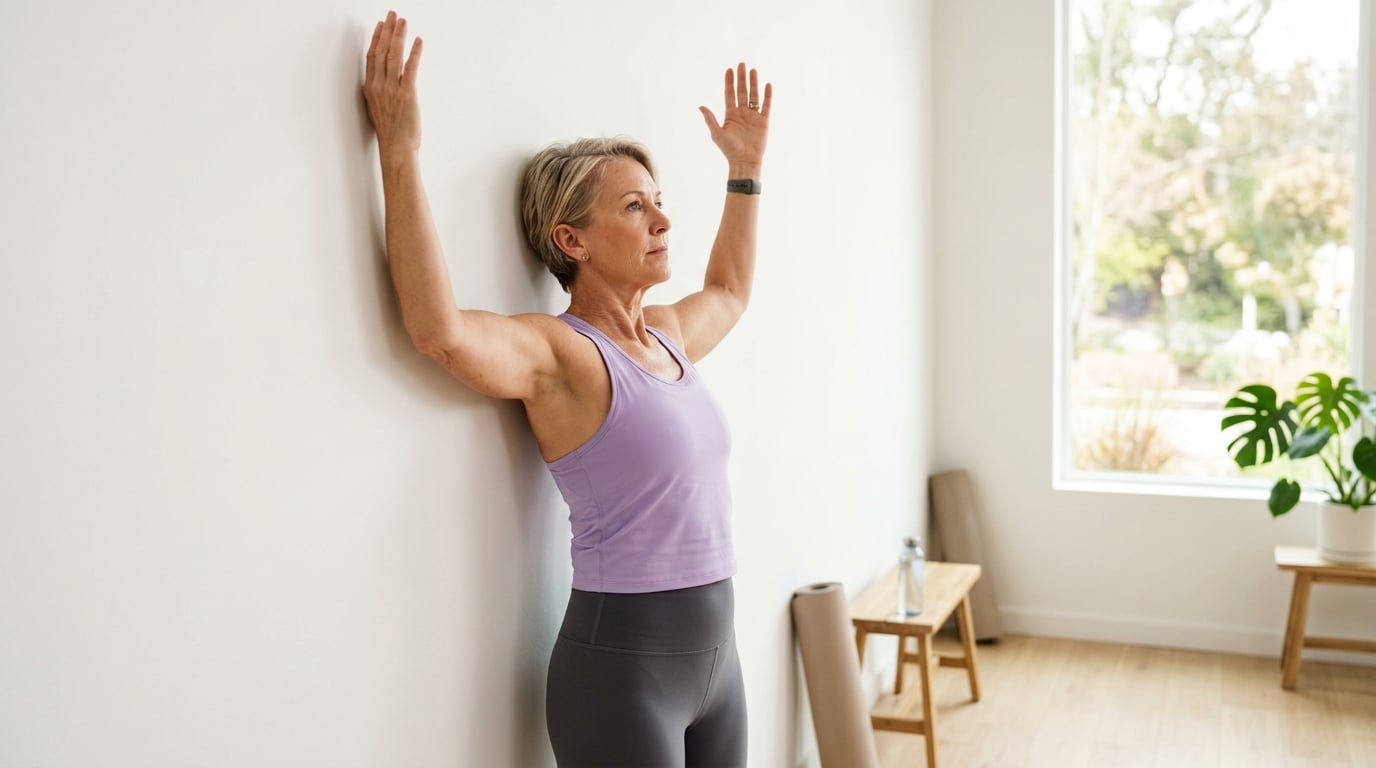
1. Wall Angels
Wall angels are the gold standard posture exercise — they strengthen the muscles between your shoulder blades while stretching your chest.
How to do it:
- Stand with your back flat against a wall, feet about 15cm from the base
- Press your head, upper back, and lower back against the wall
- Raise your arms to create a "goalpost" position — elbows at 90 degrees, backs of hands touching the wall
- Slowly slide your arms up the wall, straightening them overhead
- Slide back down to the starting position
- Keep your back, elbows, and hands in contact with the wall throughout
- Complete 10–12 repetitions
Why it works: Wall angels train the muscles responsible for scapular retraction (pulling shoulder blades together) and overhead mobility, directly counteracting the rounded-shoulder posture that develops from years of desk work and daily activities.
2. Chin Tucks
Chin tucks correct "forward head posture" — that common position where your head juts forward, adding enormous strain to your neck and upper back.
How to do it:
- Sit or stand tall with your shoulders relaxed
- Look straight ahead
- Gently draw your chin straight back, as if making a double chin
- Hold for 5 seconds — you should feel a stretch at the base of your skull
- Release and repeat 10 times
- Do this 3–4 times throughout the day
Why it works: For every inch your head sits forward, it adds approximately 4.5kg of extra strain on your neck muscles. Chin tucks retrain the deep neck flexor muscles that hold your head in proper alignment, reducing neck pain and headaches.
3. Prone Y Raises
Get your FREE 7-Day Beginner Workout Plan
A gentle, progressive week of strength, cardio, flexibility and balance — designed just for women over 50. Pop in your details and I'll send it straight away. 💪
This exercise targets the lower trapezius — a commonly weak muscle that's essential for keeping your shoulders back and your upper back straight.
How to do it:
- Lie face down on the floor (or on a bed if getting down to the floor is difficult)
- Extend your arms overhead at a 45-degree angle, forming a Y shape
- With thumbs pointing toward the ceiling, slowly lift your arms 5–10cm off the floor
- Squeeze your shoulder blades together and down
- Hold for 3 seconds
- Lower slowly and repeat 10–12 times
Why it works: The lower trapezius is the muscle that keeps your shoulder blades flat against your ribcage and pulls them downward. When it's weak, your shoulders creep up toward your ears and roll forward. Strengthening it creates the foundation for upright posture.
4. Thoracic Extension Over a Towel
This gentle stretch counteracts the forward curve of the upper back (kyphosis) that develops from years of sitting and screen use.
How to do it:
- Roll a bath towel into a firm cylinder
- Lie on your back and place the towel roll horizontally across your upper back (at bra-strap level)
- Support your head with your hands, elbows pointing toward the ceiling
- Slowly let your upper back arch over the towel roll
- Hold for 15–30 seconds, breathing deeply
- Move the towel up or down slightly and repeat to target different segments
- Do 3–5 repetitions at each position
Why it works: The thoracic spine (upper back) is designed to extend, but modern life keeps it in a flexed position. This passive stretch gently mobilises the thoracic vertebrae, improving extension range and reducing the rounded-back appearance.
5. Doorway Chest Stretch
Tight chest muscles are one of the biggest contributors to rounded shoulders. This stretch opens up the entire front of your body.
How to do it:
- Stand in a doorway with your arms in a goalpost position (elbows at 90 degrees)
- Place your forearms on either side of the doorframe
- Step one foot forward through the doorway
- Lean your body forward until you feel a stretch across your chest and the front of your shoulders
- Hold for 30–45 seconds
- Try three positions: elbows at shoulder height, above shoulder height, and below, to stretch different fibres of the pectoral muscles
Why it works: Shortened pectoral muscles physically pull your shoulders forward and inward. Regularly stretching them allows your shoulder blades to sit in their proper position, immediately improving how tall and open you look and feel.
Your Daily Posture Routine
The beauty of posture exercises is that they work best in small, frequent doses:
- Morning (3 minutes): Wall Angels (10 reps) + Chin Tucks (10 reps)
- Midday (3 minutes): Doorway Chest Stretch (30 sec × 3 positions) + Chin Tucks (10 reps)
- Evening (5 minutes): Prone Y Raises (12 reps) + Thoracic Extension (3–5 reps)
Good posture isn't about rigidly holding yourself in position — it's about training your muscles so that standing tall becomes your natural default. Start with these five exercises, be consistent, and within 2–4 weeks you'll notice you're standing taller, breathing easier, and moving with more confidence. 💪
Get your FREE 7-Day Beginner Workout Plan
A gentle, progressive week of strength, cardio, flexibility and balance — designed just for women over 50. Pop in your details and I'll send it straight away. 💪