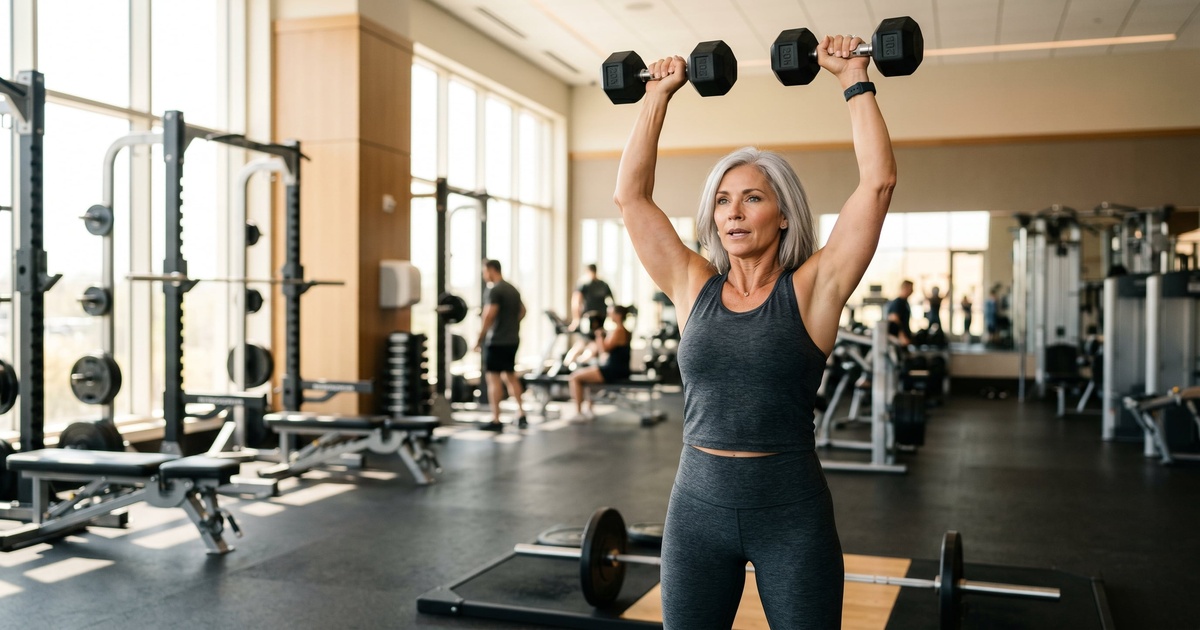
Think about how many times a day you reach overhead — putting dishes away, grabbing something from a shelf, hanging out washing, lifting luggage into an overhead locker, or even just getting dressed. Now imagine those everyday movements becoming painful, stiff, or impossible. That's what happens when your shoulders weaken and stiffen with age.
After 50, our shoulder joints become increasingly vulnerable. The rotator cuff muscles thin, cartilage wears down, and years of desk work and poor posture create imbalances that lead to pain, stiffness, and injury. Shoulder injuries are one of the most common complaints in women over 50 — and most of them are preventable with the right training.
These five exercises will build strong, stable, mobile shoulders that keep you independent and pain-free for decades to come.
1. Overhead Press
The overhead press is the single most important shoulder exercise you can do. It strengthens your deltoids (the main shoulder muscles), upper traps, and triceps — the muscles responsible for every pushing and reaching movement above your head.
How to Do It
- Stand or sit with a dumbbell in each hand at shoulder height, palms facing forward
- Brace your core and press the weights straight up overhead until your arms are fully extended
- Lower slowly back to shoulder height — take 3 seconds on the way down
- Keep your ribs down and avoid arching your lower back
Why It Matters After 50
Every time you put something on a high shelf, lift a suitcase into an overhead compartment, or reach above your head, you're performing an overhead press movement. Losing this ability is one of the earliest signs of functional decline. Strong overhead pressing keeps you independent and protects your shoulder joints from injury.
Programming
- Beginner: 2–3 kg dumbbells, 3 sets of 10–12 reps
- Intermediate: 4–6 kg dumbbells, 3 sets of 10–12 reps
- Advanced: 7–10 kg dumbbells, 4 sets of 8–10 reps
Pro tip: If standing overhead press feels unstable, start seated. A seated press removes the balance challenge and lets you focus purely on your shoulder strength.
2. Lateral Raises
Lateral raises isolate the medial (side) deltoid — the muscle that gives your shoulders their shape and width. More importantly, this muscle is responsible for lifting your arms out to the sides, a movement you use constantly in daily life.
How to Do Them
- Stand with feet hip-width apart, a light dumbbell in each hand at your sides
- With a slight bend in your elbows, raise both arms out to the sides until they're parallel with the floor
- Pause briefly at the top, then lower slowly (3 seconds down)
- Keep your shoulders down — don't let them shrug up toward your ears
Why They Matter After 50
The lateral deltoid is critical for carrying shopping bags away from your body, opening car doors, hugging someone, and stabilising your shoulder during reaching movements. It's also one of the first muscles to weaken with age, leading to that "rounded shoulder" look and increased risk of rotator cuff injuries.
Programming
- Beginner: 1–2 kg dumbbells, 3 sets of 12–15 reps
- Intermediate: 3–4 kg dumbbells, 3 sets of 12–15 reps
- Advanced: 5–6 kg dumbbells, 3 sets of 10–12 reps
Pro tip: Go lighter than you think. Lateral raises are a small-muscle isolation exercise — using too much weight recruits your traps instead of your deltoids. If your shoulders are shrugging, the weight is too heavy.
3. Front Raises
Front raises target the anterior (front) deltoid, the muscle responsible for lifting your arms in front of you. This is the movement you use every time you reach forward, pick up a child, or push a shopping trolley.
How to Do Them
- Stand with feet hip-width apart, dumbbells in front of your thighs, palms facing your body
- Keeping a slight bend in your elbows, raise one or both arms straight forward to shoulder height
- Pause briefly, then lower slowly back down
- Alternate arms or do both together — alternating is easier to control
Why They Matter After 50
The front deltoid works with your chest muscles for all pushing and reaching movements. Weak front delts contribute to difficulty with everyday tasks like pushing a heavy door open, lifting pots off the stove, or even driving (holding the steering wheel up requires sustained front deltoid endurance).
Programming
- Beginner: 1–2 kg dumbbells, 3 sets of 10–12 reps per arm
- Intermediate: 3–4 kg dumbbells, 3 sets of 10–12 reps
- Advanced: 5–6 kg dumbbells, 3 sets of 10–12 reps
Pro tip: Control the movement — no swinging. If you need to swing the weights up, they're too heavy. The value of this exercise is in the slow, controlled lift and lower.
4. Face Pulls
Get your FREE 7-Day Beginner Workout Plan
A gentle, progressive week of strength, cardio, flexibility and balance — designed just for women over 50. Pop in your details and I'll send it straight away. 💪
Face pulls are the secret weapon for shoulder health. They target the rear deltoids, upper back, and external rotators — the muscles that pull your shoulders back, improve your posture, and protect your rotator cuff from injury.
How to Do Them
- With a resistance band: Anchor the band at face height (around a door handle or sturdy post)
- Hold both ends of the band with palms facing each other
- Pull the band toward your face, driving your elbows wide and squeezing your shoulder blades together
- Your hands should end up either side of your face at the top of the movement
- Slowly return to the start position
Why They Matter After 50
Face pulls counteract the forward-rounded posture that develops from years of sitting, driving, and using phones and computers. They strengthen the posterior shoulder and upper back muscles that keep your shoulders pulled back and your spine upright. They're also the single best exercise for rotator cuff health — the rotator cuff is the most commonly injured shoulder structure in women over 50.
Programming
- Beginner: Light resistance band, 3 sets of 12–15 reps
- Intermediate: Medium resistance band, 3 sets of 12–15 reps
- Advanced: Heavy resistance band or cable machine, 3 sets of 12–15 reps
Pro tip: Think about squeezing a pencil between your shoulder blades at the top of each rep. This ensures you're actually engaging the right muscles and not just pulling with your arms.
5. Arnold Press
Named after Arnold Schwarzenegger, the Arnold press is a compound movement that hits all three heads of the deltoid in one fluid motion. The rotation element makes it especially valuable for shoulder mobility and joint health.
How to Do It
- Sit or stand with a dumbbell in each hand at shoulder height, palms facing toward you (like the top of a bicep curl)
- As you press the weights overhead, simultaneously rotate your palms to face forward
- At the top, your arms should be fully extended with palms facing away from you
- Reverse the movement — rotate your palms back toward you as you lower to the starting position
Why It Matters After 50
The Arnold press trains your shoulders through a full range of motion with rotation, which is exactly how your shoulders work in real life. Reaching into a cupboard, passing a plate across a table, or buckling a seatbelt all involve shoulder rotation. This exercise builds both strength and mobility simultaneously, which is why it's considered one of the most complete shoulder exercises ever created.
Programming
- Beginner: 2–3 kg dumbbells, 3 sets of 10 reps
- Intermediate: 4–5 kg dumbbells, 3 sets of 10–12 reps
- Advanced: 6–8 kg dumbbells, 3 sets of 8–10 reps
Pro tip: Start lighter than you would for a regular overhead press. The rotation makes this exercise more challenging because it recruits stabiliser muscles throughout the entire range of motion.
Your 20-Minute Shoulder Workout
Here's a complete shoulder session you can do 2 times per week. All you need is a pair of dumbbells and a resistance band.
| Exercise | Sets | Reps | Rest |
|---|---|---|---|
| Overhead Press | 3 | 10–12 reps | 60 sec |
| Lateral Raises | 3 | 12–15 reps | 45 sec |
| Front Raises (alternating) | 3 | 10–12 per arm | 45 sec |
| Face Pulls | 3 | 12–15 reps | 45 sec |
| Arnold Press | 3 | 10–12 reps | 60 sec |
Warm-up: 3–5 minutes of arm circles (forward and backward), shoulder rolls, and band pull-aparts. Never skip the warm-up for shoulder training — cold shoulder joints are injury-prone.
Cool-down: Gentle cross-body shoulder stretch, overhead tricep stretch, and doorway chest stretch (30 seconds each side).
Why Shoulder Strength Is Essential After 50
- Independence: Reaching overhead, carrying bags, lifting, and pushing all require strong shoulders
- Posture: Strong shoulders pull you upright and counteract the forward-hunched posture that accelerates with age
- Injury prevention: The shoulder is the most mobile — and most injury-prone — joint in your body. Strong muscles protect it
- Bone density: Weight-bearing shoulder exercises stimulate bone growth in the upper body, reducing osteoporosis risk
- Confidence: Strong, defined shoulders improve how you look and feel in everything you wear
Final Thoughts
Your shoulders are involved in virtually every upper-body movement you make. Neglect them, and everyday tasks become harder, posture deteriorates, and injury risk skyrockets. Prioritise them, and you'll stay strong, independent, and confident for years to come.
Start with the beginner weights. Focus on form. Progress when you're ready. Just 20 minutes, twice a week, is all it takes to build shoulders that serve you for life. 💪
Get your FREE 7-Day Beginner Workout Plan
A gentle, progressive week of strength, cardio, flexibility and balance — designed just for women over 50. Pop in your details and I'll send it straight away. 💪