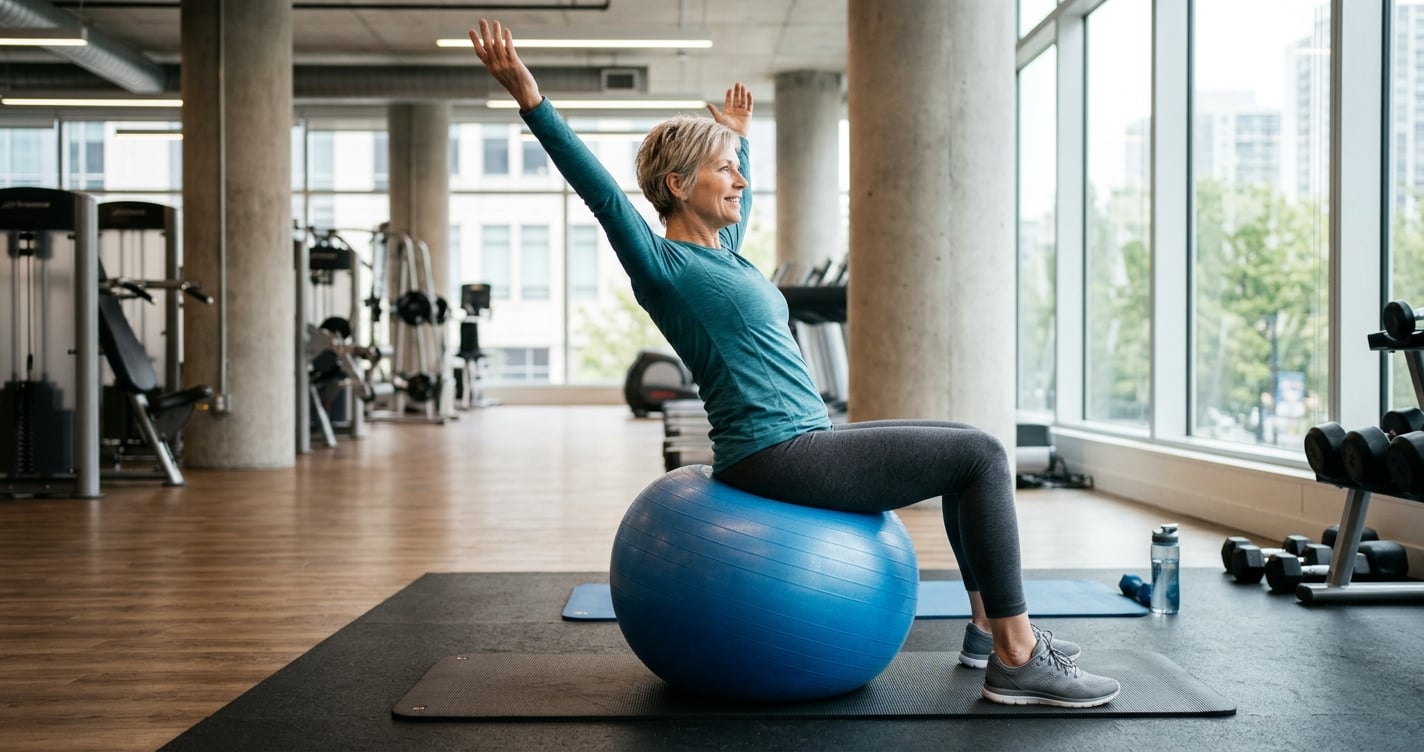
If there's one piece of fitness equipment that deserves a spot in every woman-over-50's home, it's the humble stability ball (also called a Swiss ball or exercise ball). It's affordable, surprisingly versatile, and — here's the best part — it's incredibly gentle on your joints while delivering a seriously effective workout.
The unstable surface of the ball forces your core muscles to engage constantly, improving your balance and stability without you even realising it. That's exactly what we need as we age — strong stabilising muscles that keep us steady on our feet and protect our spine.
These five stability ball exercises are beginner-friendly, easy to modify, and will work your entire body from head to toe. All you need is a properly sized ball and a little bit of space.
Choosing the Right Size Stability Ball
Getting the right size ball makes all the difference for comfort and effectiveness:
- If you're 5'0" – 5'5": Choose a 55cm ball
- If you're 5'6" – 5'11": Choose a 65cm ball
- If you're 6'0" or taller: Choose a 75cm ball
When you sit on the ball, your hips and knees should both be at roughly 90-degree angles. If in doubt, go slightly larger — you can always let a little air out.
1. Stability Ball Wall Squat
This supported squat takes pressure off your knees while still giving your thighs and glutes a thorough workout. The ball provides stability and guides proper form.
How to do it:
- Place the stability ball between your lower back and a wall
- Stand with feet hip-width apart, slightly in front of your body
- Slowly bend your knees and lower into a squat, letting the ball roll up your back
- Lower until your thighs are parallel to the floor (or as far as comfortable)
- Press through your heels to stand back up
- Repeat 10–12 times for 2–3 sets
Top tip: Keep your weight in your heels and your knees tracking over (not past) your toes. The ball should support you throughout the movement.
2. Seated Ball March
This deceptively simple exercise is a powerhouse for core stability and balance. It looks easy, but your deep stabilising muscles will be working overtime!
How to do it:
- Sit tall on the stability ball with feet flat on the floor, hip-width apart
- Place your hands on your hips or hold them out to the sides for balance
- Slowly lift your right foot 10–15cm off the floor, keeping your hips level
- Hold for 2–3 seconds, then lower and lift the left foot
- Continue alternating for 20 marches (10 each side)
- Complete 2–3 sets
Top tip: The key is keeping your hips perfectly still and level — no wobbling! If it feels too easy, try extending your lifted leg straight out in front.
3. Ball Bridge
Bridges are brilliant for strengthening your glutes and lower back, and adding the stability ball increases the challenge to your hamstrings and core. This is one of the best exercises for preventing lower back pain.
How to do it:
- Lie on your back with your calves and heels resting on top of the stability ball
- Arms are by your sides, palms down, for support
- Press your heels into the ball and lift your hips off the floor until your body forms a straight line from shoulders to heels
- Squeeze your glutes at the top and hold for 3 seconds
- Slowly lower back down
- Repeat 10–12 times for 2–3 sets
Top tip: If the ball feels too unstable, start with your feet on the floor and the ball under your upper back instead. Build up to the full version as your confidence grows.
4. Stability Ball Back Extension
Get your FREE 7-Day Beginner Workout Plan
A gentle, progressive week of strength, cardio, flexibility and balance — designed just for women over 50. Pop in your details and I'll send it straight away. 💪
A strong back is essential for good posture, and this gentle extension exercise strengthens the muscles along your spine without the jarring impact of machine-based exercises.
How to do it:
- Drape yourself face-down over the stability ball with the ball under your hips and lower belly
- Toes are on the floor behind you for stability (brace against a wall if needed)
- Place your hands behind your head or cross them over your chest
- Slowly lift your chest off the ball, extending your back until your body is in a straight line
- Hold for 2 seconds, then slowly lower
- Repeat 10–12 times for 2–3 sets
Top tip: Keep the movement controlled and avoid over-arching your back. Think "lengthening" rather than "bending backward."
5. Ball Pass (Dead Bug Variation)
This core exercise is fantastically effective without putting any strain on your neck or back. It targets your deep abdominal muscles — the ones that act like a natural corset supporting your spine.
How to do it:
- Lie on your back with knees bent and feet off the floor (tabletop position)
- Hold the stability ball between your hands, arms extended above your chest
- Place the ball between your knees and squeeze to hold it
- Extend your arms overhead and your legs away from you simultaneously (only as far as you can while keeping your lower back pressed to the floor)
- Bring everything back to centre and pass the ball back to your hands
- Repeat the pass 8–10 times for 2–3 sets
Top tip: The moment your lower back starts to arch off the floor, you've gone too far. Shorten the range of motion and focus on keeping your core braced throughout.
Your Complete Stability Ball Workout
Combine all five exercises into a 20-minute full-body routine:
- 5-minute warm-up (march on the spot or gentle walk)
- Wall Squats — 12 reps × 3 sets
- Seated Ball March — 20 marches × 3 sets
- Ball Bridge — 12 reps × 3 sets
- Back Extension — 10 reps × 2 sets
- Ball Pass — 10 passes × 2 sets
- Cool-down stretches on the ball (drape over it for a gentle back stretch)
Safety Tips for Stability Ball Training
- Inflate properly: An under-inflated ball won't provide enough challenge; over-inflated increases fall risk
- Use on a non-slip surface: Carpet or a yoga mat prevents the ball from sliding
- Start near a wall: Until you build confidence, having a wall nearby for support is perfectly fine
- Wear proper shoes: Trainers with good grip prevent your feet from slipping
- Progress gradually: Master the basic version before adding any variations
- Check your ball regularly: Look for wear, cracks, or soft spots before each use
A stability ball is one of the smartest investments you can make for your fitness after 50. It's gentle, effective, and makes exercise feel less like "working out" and more like play. Give these exercises a go — your core, your balance, and your back will all thank you! 💗
Get your FREE 7-Day Beginner Workout Plan
A gentle, progressive week of strength, cardio, flexibility and balance — designed just for women over 50. Pop in your details and I'll send it straight away. 💪