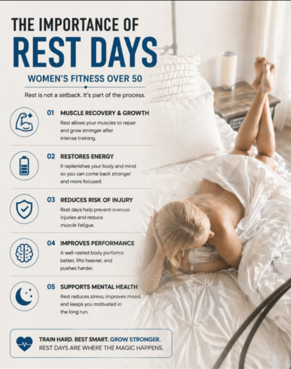
We live in a culture that glorifies the grind. More reps, more sets, more sessions. But here's the truth that every fit woman over 50 needs to hear: rest days are not a setback. They're part of the process.
If you're someone who feels guilty for taking a day off, or you think that skipping a workout means you're falling behind — this article is for you. Because understanding rest days might be the single most important thing you can do for your fitness journey.
1. Muscle Recovery & Growth
Here's something most people don't realise: you don't build muscle IN the gym. You build it while you rest.
When you exercise — especially resistance training — you create tiny micro-tears in your muscle fibres. This is completely normal and actually necessary for growth. But the repair and rebuilding process happens during recovery, not during the workout itself.
After 50, this recovery process takes a little longer than it did in your twenties. Your body still has an incredible ability to adapt and grow stronger, but it needs adequate time to do so. Without proper rest, those micro-tears don't fully heal, and instead of getting stronger, you end up breaking down.
Rest allows your muscles to repair and grow stronger after intense training. It's when the magic actually happens. So the next time you feel guilty about a rest day, remind yourself: your muscles are literally growing right now.
2. Restores Energy
Ever noticed that after a few consecutive days of hard training, your energy starts to tank? You feel sluggish, your workouts feel harder than they should, and even simple tasks feel exhausting.
That's your body telling you it needs a break.
Rest days replenish your body and mind so you can come back stronger and more focused. They restore your glycogen levels (the fuel your muscles use during exercise), rebalance your hormones, and give your nervous system a chance to recover.
For women over 50, this is especially important. Hormonal changes during and after menopause can already affect energy levels, sleep quality, and recovery. Adding relentless training on top of that is a recipe for burnout.
A well-timed rest day doesn't make you weaker — it makes your next workout so much better. You'll walk into the gym with more energy, more focus, and more power.
3. Reduces Risk of Injury
This one is critical, especially as we get older.
Overtraining puts enormous stress on your joints, tendons, ligaments, and muscles. When you don't give your body time to recover, the risk of overuse injuries skyrockets. We're talking about stress fractures, tendonitis, muscle strains, and joint inflammation.
After 50, your connective tissues take longer to repair. Your joints may already be dealing with normal age-related wear. Pushing through without rest doesn't make you tough — it makes you vulnerable to injuries that could sideline you for weeks or even months.
Rest days help prevent overuse injuries and reduce muscle fatigue. Think of them as an insurance policy for your body. A day of rest now prevents weeks of forced rest later.
The smartest athletes aren't the ones who never rest. They're the ones who rest strategically.
4. Improves Performance
Get your FREE 7-Day Beginner Workout Plan
A gentle, progressive week of strength, cardio, flexibility and balance — designed just for women over 50. Pop in your details and I'll send it straight away. 💪
This might sound counterintuitive, but taking rest days actually makes you perform better.
A well-rested body performs better, lifts heavier, and pushes harder. When you're properly recovered, your reaction time improves, your coordination sharpens, and your strength output increases. You'll notice that your exercises feel smoother, your form is better, and you can push through plateaus that seemed impossible when you were overtrained.
Research consistently shows that athletes who incorporate strategic rest days into their training programs outperform those who train every single day. The principle of supercompensation — where your body rebounds to a level above your previous fitness after adequate recovery — only works if you actually allow the recovery to happen.
So if you've been stuck at the same weight on your squats, or your running pace has plateaued, the answer might not be more training. It might be more rest.
5. Supports Mental Health
Let's talk about the mental side — because fitness isn't just physical.
Constant training without breaks can lead to mental burnout, anxiety, and a complicated relationship with exercise. When working out starts to feel like an obligation rather than something you enjoy, that's a red flag.
Rest days reduce stress, improve mood, and keep you motivated in the long run. They give your mind a break from the discipline of training and remind you that your worth isn't measured by how many sessions you logged this week.
For women over 50, mental health is just as important as physical health. Stress management, emotional well-being, and finding joy in movement are all essential parts of a sustainable fitness lifestyle. Rest days protect all of that.
Use your rest day to do something that fills your soul — a walk on the beach, reading a book, spending time with people you love, or simply doing nothing at all. That's not laziness. That's self-care.
What Does a Good Rest Day Look Like?
Rest doesn't necessarily mean lying on the couch all day (although that's perfectly fine sometimes). Here are some ideas for active and passive recovery:
- Gentle walking — a 20-30 minute easy walk gets blood flowing without taxing your muscles
- Stretching or yoga — helps maintain flexibility and reduce stiffness
- Foam rolling — releases muscle tension and improves circulation
- Swimming — low-impact and therapeutic for joints
- Complete rest — sometimes doing nothing is exactly what your body needs
The key is listening to your body. Some weeks you might need one rest day. Other weeks you might need two or three. There's no shame in that — it's wisdom.
How Many Rest Days Do You Need?
For women over 50 doing regular resistance training and cardio, a good guideline is:
- 2-3 rest days per week if you're training intensely
- 1-2 rest days per week if your training is moderate
- At least 1 full rest day every week — no exceptions
Pay attention to these signs that you need a rest day: persistent fatigue, decreased performance, mood changes, trouble sleeping, increased soreness, or getting sick more often.
The Bottom Line
Train hard. Rest smart. Grow stronger.
Rest days aren't the enemy of progress — they're the foundation of it. Every strong, fit woman over 50 who's thriving in her training has one thing in common: she knows when to push and when to pause.
Your body is incredible. Give it the rest it deserves, and it will reward you with strength, energy, and resilience for years to come.
Rest days are where the magic happens. ✨
Get your FREE 7-Day Beginner Workout Plan
A gentle, progressive week of strength, cardio, flexibility and balance — designed just for women over 50. Pop in your details and I'll send it straight away. 💪