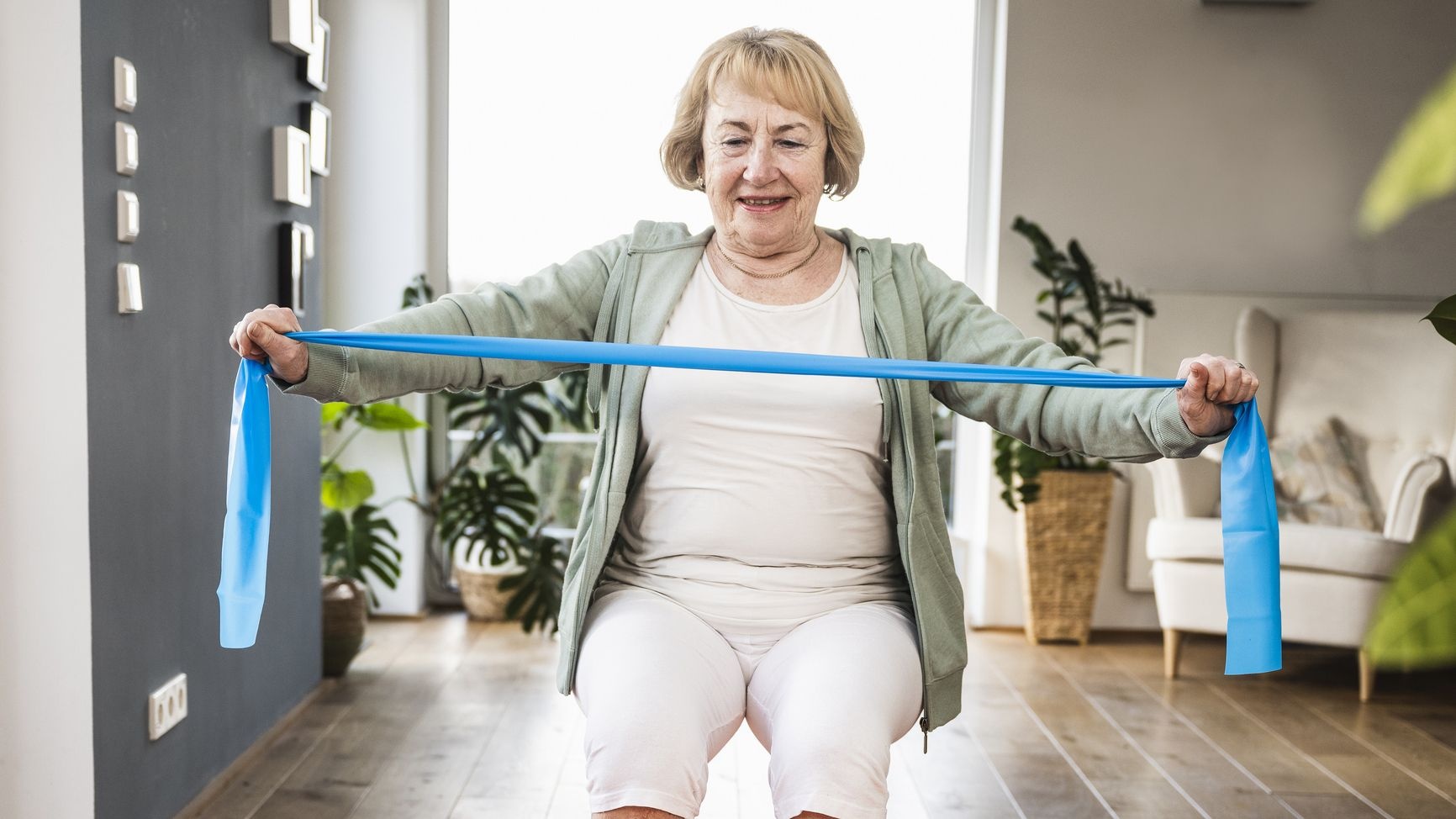
If you're new to strength training and the idea of lifting heavy weights feels intimidating, resistance bands are your perfect starting point. They're gentle on joints, incredibly versatile, cheap to buy, and you can use them anywhere — your living room, garden, or hotel room.
Here are 4 beginner-friendly resistance band exercises that build real strength, improve your balance, and protect your bones — all without stepping foot in a gym.
Why Resistance Bands Are Perfect After 50
Resistance bands offer some unique advantages over traditional weights, especially for beginners over 50:
- Joint-friendly — bands provide smooth, constant tension without the jarring impact of heavy weights
- Adjustable difficulty — simply change band thickness or adjust your grip position to make it easier or harder
- Full range of motion — bands work your muscles through the entire movement, not just at one point
- Portable — throw them in a bag and you have a gym wherever you go
- Affordable — a set of bands costs $15–30 and lasts for years
- Low injury risk — if you drop a band, it doesn't land on your foot
Research shows that resistance band training builds muscle and strength just as effectively as free weights — especially for beginners. The key is consistency and progressive challenge.
The 4 Exercises
Get your FREE 7-Day Beginner Workout Plan
A gentle, progressive week of strength, cardio, flexibility and balance — designed just for women over 50. Pop in your details and I'll send it straight away. 💪
1. Banded Squat 🏋️♀️
The squat is the king of lower body exercises. It works your quads, glutes, hamstrings, and core — all essential muscles for standing up, sitting down, climbing stairs, and maintaining independence.
How to do it:
- Stand on the band with feet shoulder-width apart
- Hold the other end of the band at shoulder height (or loop it over your shoulders)
- Push your hips back and bend your knees, lowering as if sitting into a chair
- Keep your chest up and weight in your heels
- Push through your heels to stand back up — the band adds resistance at the top
- 3 sets of 10–12 reps
Modification: If depth is an issue, place a chair behind you and squat down until your glutes just touch it, then stand back up. This gives you a depth target and safety net.
Why it matters after 50: Strong legs = independence. Squats improve your ability to get up from chairs, use the toilet, and climb stairs without assistance. They also strengthen your knee joints and improve bone density in your hips and spine.
2. Seated Row (Back Strengthener) 💪
Most people over 50 have weak upper back muscles from years of sitting, driving, and looking at screens. A strong back is essential for good posture, shoulder health, and preventing that rounded "hunch" that creeps in with age.
How to do it:
- Sit on the floor with legs extended in front of you (or sit on a chair with feet flat)
- Loop the band around your feet
- Hold the band with both hands, arms extended
- Pull the band towards your belly button, squeezing your shoulder blades together
- Keep your back straight — don't lean back to pull
- Slowly release back to start
- 3 sets of 12–15 reps
Modification: Use a lighter band or don't pull as far back if it's too difficult. Focus on feeling the squeeze between your shoulder blades.
Why it matters after 50: Counteracts the forward-rounded posture that causes neck pain, headaches, and shoulder problems. A strong back also supports your spine and reduces risk of compression fractures.
3. Standing Lateral Raise (Shoulder Builder) 🙌
Your shoulders are involved in almost every upper body movement — reaching overhead, carrying groceries, lifting grandchildren, even getting dressed. Strong shoulders mean fewer injuries and better functional fitness.
How to do it:
- Stand on the centre of the band with both feet
- Hold one end of the band in each hand, arms at your sides
- With a slight bend in your elbows, lift your arms out to the sides until they reach shoulder height
- Hold for a moment at the top — squeeze your shoulders
- Lower slowly back down
- 3 sets of 10–12 reps
Modification: Stand on the band with just one foot to reduce resistance. Or lift only to 45 degrees instead of full shoulder height.
Why it matters after 50: Shoulder injuries are extremely common after 50, particularly rotator cuff problems. Strengthening the deltoid muscles with bands provides protection and improves your ability to reach, push, and carry objects overhead.
4. Glute Bridge with Band (Booty & Core) 🏠
The glute bridge targets your glutes, hamstrings, and core — three muscle groups that are critical for hip stability, lower back health, and walking power. Weak glutes are one of the most common causes of lower back pain after 50.
How to do it:
- Lie on your back with knees bent, feet flat on the floor
- Place the band just above your knees
- Press your knees outward against the band (this activates your side glutes)
- Push through your heels to lift your hips towards the ceiling
- Squeeze your glutes hard at the top — hold for 2 seconds
- Lower slowly back down
- 3 sets of 12–15 reps
Modification: Start without the band to master the hip lift, then add the band once you're comfortable with the movement.
Why it matters after 50: Your glutes are the biggest muscles in your body, but they "switch off" from too much sitting. Reactivating them protects your lower back, improves your walking stride, and makes everything from climbing stairs to standing from a chair easier.
Your Beginner Workout Plan
Do this full routine 3 times per week, with at least one rest day between sessions:
- Banded Squat — 3 sets of 10–12 reps
- Seated Row — 3 sets of 12–15 reps
- Standing Lateral Raise — 3 sets of 10–12 reps
- Glute Bridge with Band — 3 sets of 12–15 reps
Total time: 15–20 minutes. Rest 30–60 seconds between sets.
What Band Should You Buy?
- Beginners: Start with a light or medium resistance band (usually yellow or green)
- Look for a set: Most sets come with 3–5 bands of increasing resistance — perfect for progressing over time
- Loop vs tube: Loop bands (flat circles) are great for lower body; tube bands with handles work well for upper body. A set of both is ideal
- Budget: $15–30 for a quality set that lasts years
The Bottom Line
You don't need a gym, a personal trainer, or heavy weights to build real strength after 50. A single resistance band and 15 minutes, 3 times a week is enough to build muscle, protect your joints, improve your balance, and boost your confidence.
Start today. Your stronger self is waiting. 💪
Get your FREE 7-Day Beginner Workout Plan
A gentle, progressive week of strength, cardio, flexibility and balance — designed just for women over 50. Pop in your details and I'll send it straight away. 💪