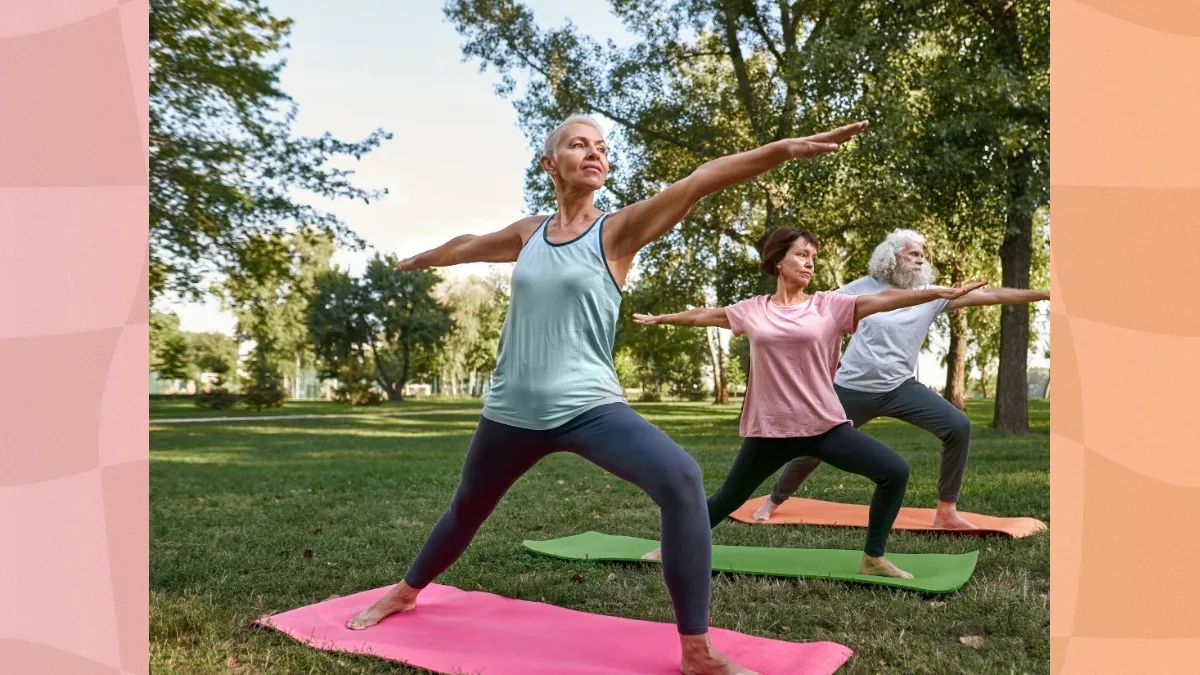
Here’s a stat that should get your attention: 1 in 3 adults over 65 will experience a fall each year. And most of those falls aren’t caused by tripping over something — they’re caused by poor balance.
The good news? Balance is a skill, not a talent. It can be trained, improved, and maintained at any age — and the exercises that do it are simple, gentle, and require zero equipment.
Here are 5 balance exercises every woman over 50 should be doing regularly. They take less than 15 minutes, you can do them in your living room, and they could genuinely save you from a life-changing injury.
Why Balance Gets Worse After 50
Balance isn’t just about your legs — it’s a complex system involving your muscles, inner ear, vision, and nervous system all working together. After 50, several things start to change:
- Muscle loss (sarcopenia) — especially in your legs, ankles, and core — the muscles that keep you upright
- Slower reflexes — your body takes longer to correct when you stumble
- Inner ear changes — the vestibular system (your internal balance sensor) becomes less sensitive
- Reduced proprioception — your body’s ability to sense where it is in space declines
- Vision changes — depth perception and peripheral vision weaken
- Lower bone density — meaning a fall that would bruise a 30-year-old could fracture a bone at 60
This isn’t meant to scare you — it’s meant to motivate you. Because every single one of these factors responds to training. Balance exercises literally rewire the connections between your brain and body.
The 5 Exercises
1. Single-Leg Stand 🦶
The most fundamental balance exercise there is — and one of the most revealing. If you can’t stand on one leg for 10 seconds, research shows your fall risk is significantly higher. But here’s the thing: this improves fast with practice.
How to do it:
- Stand near a wall or sturdy chair (for safety, not support)
- Shift your weight onto your right foot
- Lift your left foot a few centimetres off the ground
- Hold for 10–30 seconds, focusing on a spot in front of you
- Repeat on the other side
- Do 3 rounds each leg
Progressions:
- Week 1–2: Touch the wall lightly for support
- Week 3–4: Hover your hand near the wall but don’t touch
- Week 5+: Close your eyes (this is incredibly challenging — your balance system has to work much harder without visual input)
Why it’s save-worthy: This single exercise trains your ankle stabilisers, hip muscles, and core simultaneously. Do it while waiting for the kettle to boil — it takes 3 minutes.
2. Heel-to-Toe Walk (Tandem Walk) 🚶♀️
This one looks easy but challenges your balance in a completely different way — it trains dynamic balance (staying stable while moving), which is what you actually need in real life.
How to do it:
- Stand tall in a hallway or near a wall
- Place one foot directly in front of the other, heel touching toe
- Walk forward in a straight line, placing each foot heel-to-toe
- Keep your eyes focused on a point ahead
- Walk 15–20 steps forward, then turn and walk back
- Repeat 3 times
Tips:
- Arms out to the side can help initially
- If you wobble, that’s perfect — your body is learning to self-correct
- Try it on different surfaces as you improve (carpet, grass, slightly uneven ground)
Why it’s save-worthy: This mimics the narrow-base walking patterns that cause most falls — navigating tight spaces, turning corners, stepping over objects. Training it makes those situations safer.
3. Sit-to-Stand (No Hands) 🪑
This exercise does double duty — it builds leg strength AND balance at the same time. Getting up from a chair without using your hands is one of the best functional fitness tests for adults over 50.
How to do it:
- Sit on a sturdy chair with feet flat on the floor, hip-width apart
- Cross your arms over your chest
- Lean slightly forward, then stand up using only your legs
- Pause at the top — stand tall and squeeze your glutes
- Slowly lower yourself back down with control (don’t plop)
- 3 sets of 8–10 reps
Progressions:
- Beginner: Use a higher chair or push lightly off the armrests
- Intermediate: Arms crossed, standard chair height
- Advanced: Slow the lowering phase to 3–4 seconds (this is hard!)
Why it’s save-worthy: The ability to get up from a chair unassisted is directly linked to independence as you age. If you lose this, you lose freedom. This exercise protects it.
4. Clock Reaches ⏰
This exercise challenges your balance in multiple directions — not just forward and back. It trains your body to stay stable when reaching, turning, or shifting weight unexpectedly.
How to do it:
- Stand on your right leg (near a wall for safety)
- Imagine you’re standing in the centre of a clock face
- With your left foot, reach towards 12 o’clock (forward), tap the ground lightly, return to centre
- Reach towards 3 o’clock (side), tap, return
- Reach towards 6 o’clock (behind), tap, return
- Reach towards 9 o’clock (other side), tap, return
- That’s 1 round. Do 3 rounds each leg
Why it’s save-worthy: Falls rarely happen in a straight line. They happen when you reach sideways for something, turn unexpectedly, or step in an unusual direction. Clock reaches train your body to handle all of these.
5. Calf Raises (with Hold) 🦶
Your calf muscles and ankles are your first line of defence against falls. They make the constant micro-adjustments that keep you upright without you even thinking about it. Strong calves = better balance, full stop.
How to do it:
- Stand with feet hip-width apart, holding a chair or countertop lightly
- Rise up onto your toes as high as you can
- Hold at the top for 3 seconds — this is where the balance magic happens
- Lower slowly back down (don’t drop)
- 3 sets of 12–15 reps
Progressions:
- Beginner: Hold the chair with both hands
- Intermediate: One hand on the chair, or just fingertips
- Advanced: No hands, or single-leg calf raises (this is seriously challenging)
Why it’s save-worthy: Ankle weakness is a hidden cause of falls that most people overlook. Strong calves improve your walking stability, stair confidence, and ability to recover from stumbles.
Your 15-Minute Balance Routine
Get your FREE 7-Day Beginner Workout Plan
A gentle, progressive week of strength, cardio, flexibility and balance — designed just for women over 50. Pop in your details and I'll send it straight away. 💪
Do this 3–4 times per week for best results. You’ll notice improvements within 2–3 weeks.
- Single-Leg Stand — 3 rounds each leg, 10–30 sec holds (3 min)
- Heel-to-Toe Walk — 3 laps of 15–20 steps (3 min)
- Sit-to-Stand — 3 sets of 8–10 reps (3 min)
- Clock Reaches — 3 rounds each leg (4 min)
- Calf Raises with Hold — 3 sets of 12–15 reps (2 min)
Total: about 15 minutes. No equipment. No gym. Just you and a chair.
When to Do These Exercises
- Morning: After your stretching routine (pair with the 5 morning stretches!)
- Throughout the day: Single-leg stands while cooking, calf raises while brushing teeth
- Before a walk: A quick balance warm-up makes your walk safer and more effective
- Dedicated sessions: 3–4 times per week for 15 minutes
Warning Signs Your Balance Needs Work
If any of these sound familiar, balance training should be a priority:
- You grab furniture or walls when walking around the house
- You feel unsteady on stairs or escalators
- You avoid walking on uneven surfaces like grass or gravel
- You can’t stand on one leg for 10 seconds
- You’ve had a near-miss or actual fall in the past year
- You feel dizzy when you turn your head quickly
- You’ve stopped doing activities because you’re afraid of falling
If you ticked even one of those, these exercises are for you. And the sooner you start, the faster you’ll see improvement.
The Bottom Line
Falls are the leading cause of injury in adults over 50 — but they’re also one of the most preventable. You don’t need fancy equipment, a gym membership, or athletic ability. You just need 15 minutes, a chair, and the commitment to show up 3–4 times a week.
Your future self will thank you for every single rep. Start today. Stay standing. Stay strong. 💪
Get your FREE 7-Day Beginner Workout Plan
A gentle, progressive week of strength, cardio, flexibility and balance — designed just for women over 50. Pop in your details and I'll send it straight away. 💪